Biggest ERP Failures of 2010

pc pointed out a great little article in a post on the discussion forum.

The article touches lightly on why ERP implementations are so hazard prone, and then lists the “Biggest Failures” of 2010.

Of note is that the majority of the listed failures are governments. I can see why. Governments, by their nature, have a harder time concealing the budget over runs, process breakdowns and other failures that are endemic with these implementations.

A corporation can have the same, or even a worse, experience, but we are unlikely to know. They are going to make the best of it, work around it, and make benign sounding declarations such as “the ERP implementation is six months behind schedule” if for no other reason than to protect themselves from shareholders questioning their competence.

Does anybody have any of their own stories to share?
Keep Visual Controls Simple

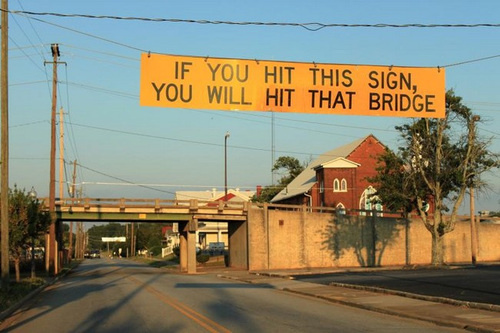
In this world of laser beams and ultrasonic transducers, we sometimes lost sight of simplicity.

Remember- the simplest solution that works is probably the best. A good visual control should tell the operator, immediately, if a process is going beyond the specified parameters.

Ideally the process would be stopped automatically, however a clear signal to stop, given in time to avoid a more serious problem, is adequate.

So, in that spirit I give you (from Gizmodo) the following example:

Warning Sign

Motivation, Bonuses and Key Performance Indicators

I have posted a few times about the “management by measurement” culture and how destructive it can be. This TED video by Daniel Pink adds some color to the conversation.

Simply put, while traditional “incentives” tend to work well when the task is rote and the solution is well understood, applying those same incentives to situations where creativity is required will reduce people’s performance.

We saw this in Ted Wujec’s Marshmallow Challenge video as well, where an incentive reduced the success rate of the teams to zero.

This time of year companies are typically reviewing their performance and setting goals and targets for next year.

It is important to keep in mind that there is overwhelming evidence that tying bonuses to key performance indicators is the a reliable way to reduce the performance of the company.

Teaching the Scientific Method on TV

So the Mythbusters are teaching the scientific method as entertainment, and somehow industry is not making the leap that the same thinking applies to management.

Do financial management methods developed by Alfred P. Sloan have such a mass and momentum that there is no way to overcome?

All of the discussions about “change” in the organization really come down to trying to overpower the way business leaders have been taught to think about decision making.

He Should Have Seen It

In many processes, we ask people to notice things. Often we do this implicitly by blaming people when something is missed. This is easy to do in hindsight, and easy to do when we are investigating and knowing what to look for. But in the real world, a lot of important information gets lost in the clutter.

We talk about 5S, separating the necessary from the unnecessary, a lot, but usually apply it to things.

What about information?

How is critical information presented?

How easy is it for people to see, quickly, what they must?

This is a huge field of study in aviation safety where people get hyper focused on something in an emergency, and totally miss the bigger picture.

This site has a really interesting example of how subtle changes in the way information is presented can make a huge difference for someone trying to pull out what is important. The context is totally different, so our challenge is to think about what is revealed here, and see if we can see the same things in the clutter of information we are presenting to our people.

The purpose of good visual controls is to tell us, immediately, what we must pay attention to. Too many of them, or too much detail – trying to present everything to everyone – has the opposite effect.