Bill Costantino: Toyota Kata “Unified Field Theory”

Mike Rother and Bill Costantino have shared a presentation titled “Toyota Kata Unified Field Theory.”

I think it nicely packages a number of concepts in an easy-to-understand flow.

I want to expand on a couple of points but first take a look at the presentation.

This is a direct URL to the original SlideShare version: http://www.slideshare.net/BillCW3/toyota-kata-unified-field-theory

Challenges and Campaigns

First of all, this presentation differentiates between a “challenge” and the target condition. That is important, and (in my opinion) had not been as clear in Rother’s original book.

I have been advocating setting a challenge, or campaign if you well, for some time. This is where we address a class of problems that are a major issue. Things like:

  • Too much cash tied up in working capital. (Which can be expressed a number of ways, such as improving inventory turns.)
  • Poor schedule performance – “on time delivery” becomes the theme.
  • Quality issues (too much rework, scrap, etc.)
  • Our nurses don’t have time to prepare rooms for the next patient.
  • Of course, safety can come into this arena as well, as can other issues that impact the organization’s health.
All of these things are not really problems in the sense that they can’t really be solved. These are the aggregated symptoms of lots of smaller underlying problems that accumulate into things on this list.

Setting a specific challenge doesn’t mean you ignore the other stuff. You have been coping with it and working around it for years. But you know you haven’t had time to fix everything, so stop believing that you do.

The point here is to galvanize the effort.

Chip and Dan Heath address the importance of setting the challenge in their book Switch (which I have reviewed here). They emphasize the importance of “scripting the critical moves” and “pointing to the destination” so that people have a good grasp of what is important.

Once the challenge is addressed, say “on time delivery,” it can be broken down into target objectives that are both local (large organizations need to have things broken down to what the local group is expected to work on) as well as those which cut cross-functionally. The scope of the effort is really defined by the depth of the organization’s skill at addressing the issues at this point.

Bill Costantino correctly points out that setting the vision, and deciding the theme or campaign, is a leadership function. This can’t be done by your “lean team” in a way that sticks. The discipline required here is for the leaders to maintain what Deming referred to as “consistency of purpose.”

Simply put, to say “this is the challenge” and then continuously ask about other stuff jerks people around and serves only to paralyze the organization until the leaders decide what people should spend their limited time on.

The good news is that it really doesn’t matter. If the organization can focus on One Big Thing long enough, their efforts will eventually touch on the other stuff anyway.

Jim Collins uses different words to make the same point in Good to Great with the “Hedgehog Concept.”

The Path to the Target Condition

One place where I think we can still use some more clarity is in the illustration of the path to the target condition.

This is the illustration from Slide 20 in the Slideshare version of the presentation:
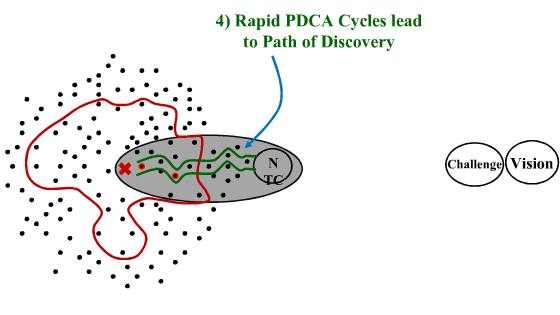
The presentation (and Rother’s coverage in Toyota Kata) is quite clear that navigation through “the grey zone” is a step-by-step process (kind of like driving off-road at night where you only see as far as your headlights).

But the “plan and execute” paradigm is very strong out there.

My experience is that people in the field see this illustration, and fully expect the green path to be set out, and the “dots” identified, along with a time line and resources required to get there. It becomes a “project.”

This is a strong symptom of the “delegate improvement” paradigm that we should all be actively refuting.

Let’s look at how I think this process actually plays out dynamically.

Initially we know where we are, we have target condition, so we know the direction we need to go to get there.

We are still inside the red line of the “current knowledge threshold.” Solving these problems is generally application of things we already know how to do, perhaps in new ways.
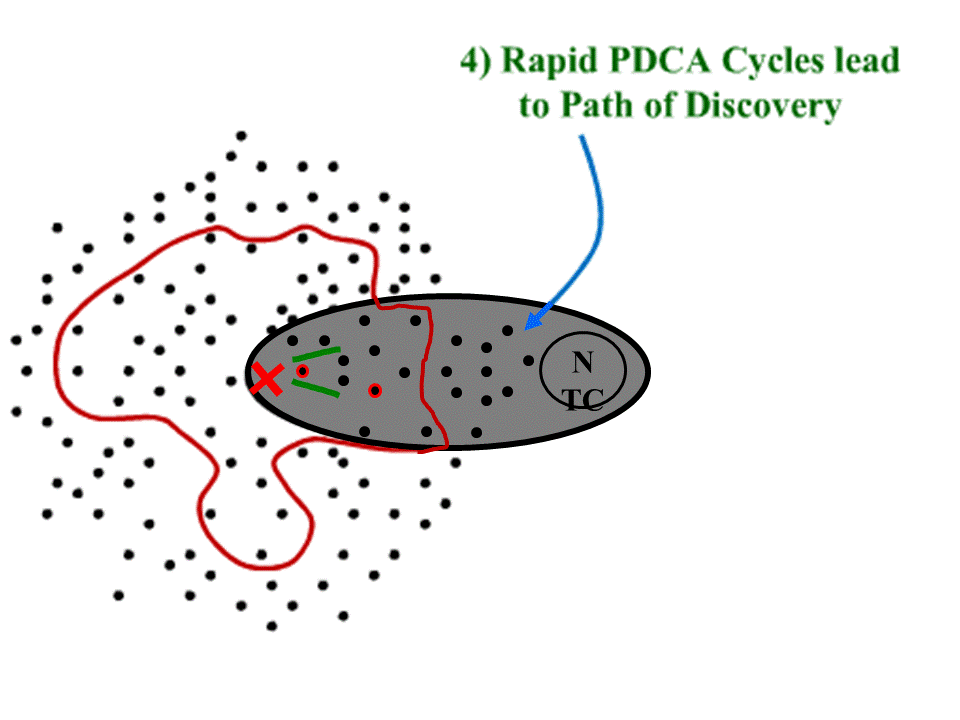
And having solved one problem, we now identify the next known barrier:
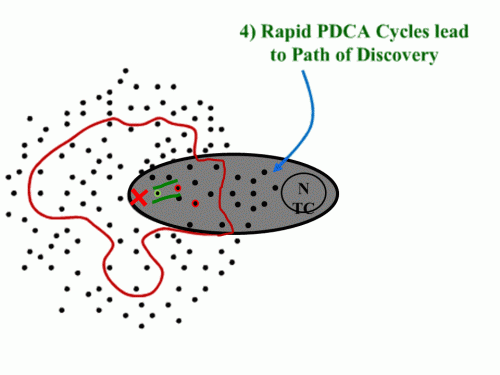
Once that one is cleared, we see a couple of choices. Which one?
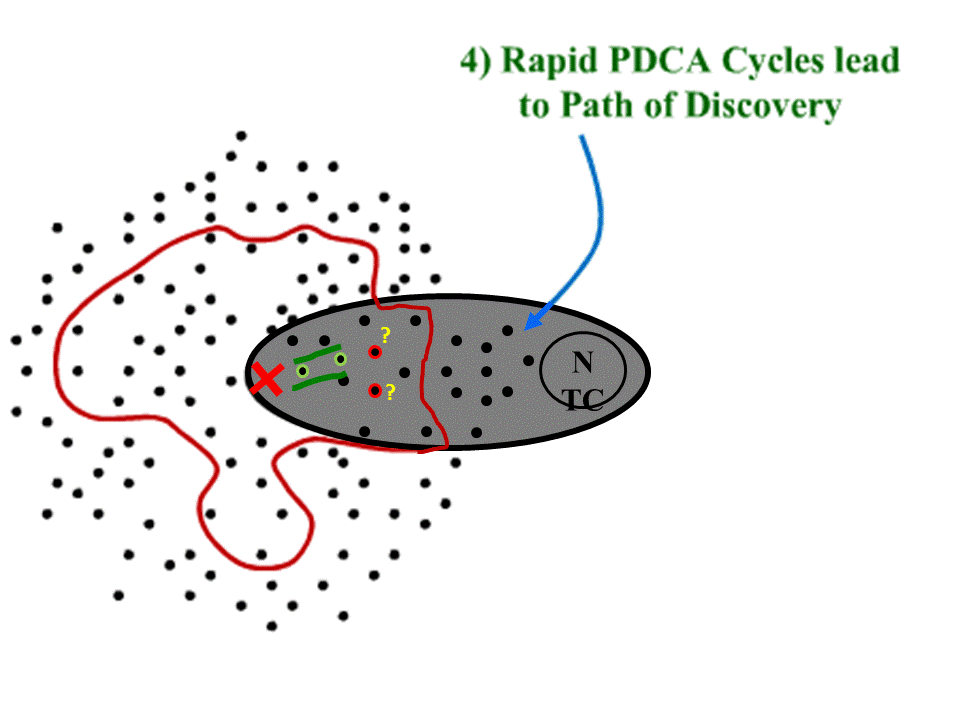
All other things being equal, pick the easiest, and move on. (As we said when I was learning rapid maneuver tactics in the Army – “haul ass and bypass.”)

Up to this point, we have been operating inside the “current knowledge threshold.” Our efforts are better focused by pursuing a clear target objective, but we aren’t really learning anything new about the process. (Hopefully we are becoming better practiced at problem solving.)

Pretty soon, though, we reach the edge, and have to push out the red line. Why? Because we can’t solve a problem we don’t understand. As we approach the boundary, things get harder because we have to do a better job assessing, and extending the knowledge threshold around the problem.

This is the essence of the problem solving process – If you can’t see the solution, you need to better understand the problem.

The process becomes one of progressively solving problems, identifying the next, and expanding our understanding. Once there is sufficient understanding to anchor knowledge and take the next step, do so. Step and repeat.

Putting the whole thing in motion, it looks like this:
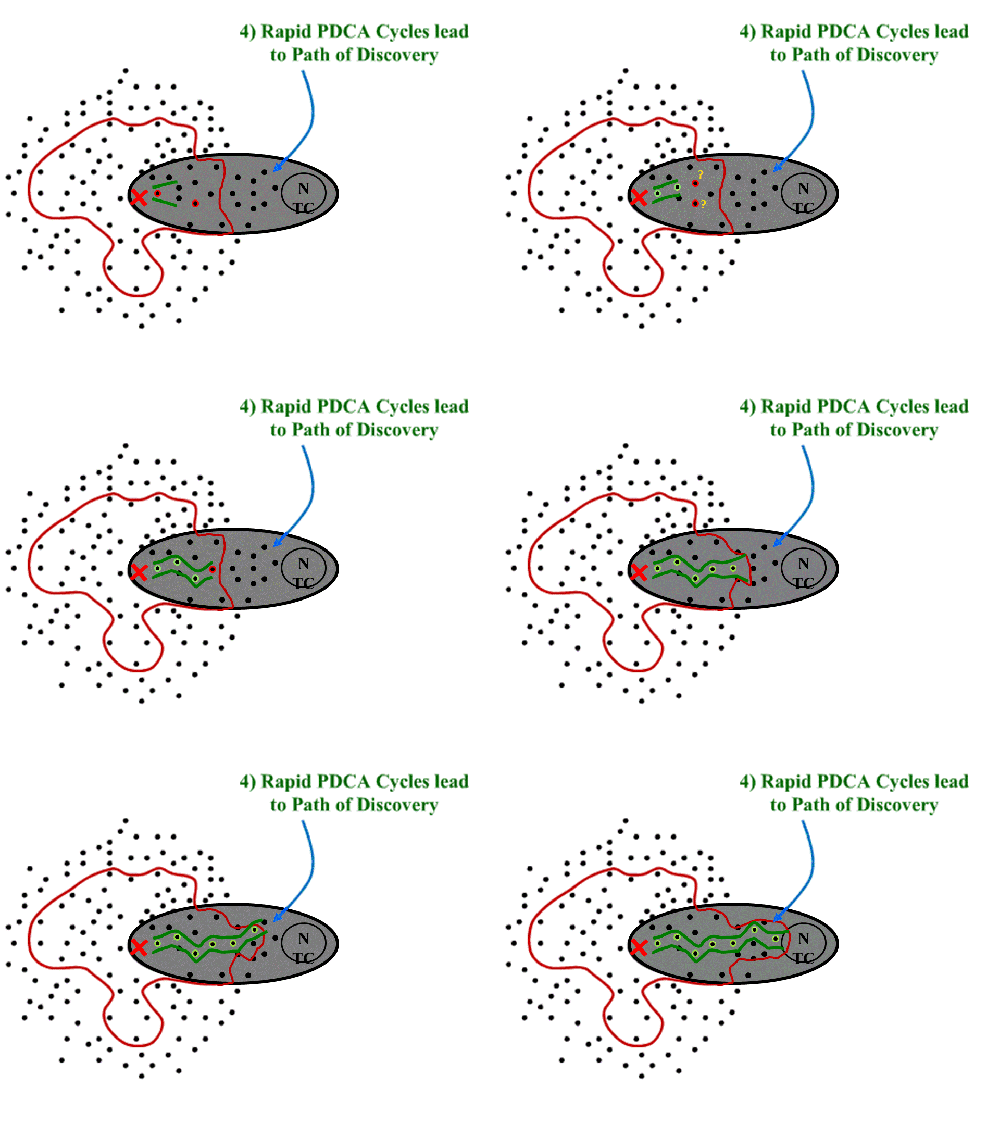
The key is that the “green path” isn’t set out as a predictable trajectory. It is hacked out of the jungle as you go. You know you are going, are confident you can get there, but aren’t sure of exactly what issues will be encountered along the way.

Let me apply my “Project Apollo Test” to this process.

Vision: “The USA will be the undisputed leader in space exploration.” Vague, a long way out there, but compelling.

Challenge, Theme: “…before this decade is out, […] landing a man on the moon and returning him safely to the Earth.” In 1961, a serious challenge, but considered do-able based on extrapolating what we knew.

At this point, though, space exploration was exploring a lot of different things. Building a space station, reusable launch vehicles, pretty much the whole gamut was being explored by someone, somewhere. The effort wasn’t focused. The “man on the moon” goal focused it. Every thing was pretty much dropped except solving the problems that were in the way of making Lunar Orbit Rendezvous work.

There were four target conditions that had to be cleared.

Build and test the Big Honkin’ Rocket called the Saturn V plus the infrastructure to launch them in rapid succession.

And they had to answer three questions:

  1. Can people spend two weeks in space without serious physical or psychological problems?
  2. Can we build a space suit that lets someone operate outside the protection of a space craft?
  3. Can one space craft maneuver, rendezvous and dock with another?

Of course each of these objectives, in turn, had lots of smaller challenges. NASA’s effort between 1962 and 1966 was focused on answering these three questions.

In doing so, the threshold of knowledge expanded well beyond the immediate issues.

Yup, I’d say this thinking works, and it scales up.

Why did I go through this little exercise? Because if this thinking can put people on the moon, it is probably powerful enough to move your organization into new territory.

Back on Earth, a company undertaking “lean” needs to really grasp that they need to be committing to embracing this process. There are clear things that leaders need to do to make it work, and those things go beyond “supporting” or “sponsoring” the effort. We’ll get into some details on the next few posts as we continue to build on Rother’s and Costantino’s work.


Theory Tests Reality, Reality Tests Theory

“Experience by itself teaches nothing… Without theory, experience has no meaning. Without theory, one has no questions to ask. Hence, without theory, there is no learning.”

–W. Edwards Deming, The New Economics for Industry, Government, Education – 2nd Edition

The field of psychology, it seems, shares an issue with the field of operations management.

Wilson and Golonka, psychologists who blog on Notes From Two Scientific Psychologists lament about the lack of a unifying theory in their field in Theory, and Why Its Time Psychology Got One.

This is fairly heavy reading since it is likely from outside your field, but the core message is here (paragraph breaks added for readability):

Theory in Science
As I try to teach my students, the role of theory in science is to provide structure to your data. A good theory rules explanations in and out, and if it rules out the wrong explanation that will become clear over time as you pursue your theory guided research.

Good science means a) restricting your explanatory mechanisms to include things your theory allows, and b) keeping an eye on how well that’s working out for you, while c) allowing yourself to rest on your well supported theory to resist breaking the rules as long as you can.

As Deming points out in the quote at the top of this post, having a theory – a solid statement of what you believe is true is a prerequisite for learning to take place. Without that theory, events and information simply get filed away as “interesting.”

With a theory, each is compared against the prevailing thought and forces us to reflect on our understanding.

Sure, we run into confirmation bias (where we unconsciously exclude things that contradict our beliefs) and other logical flaws, but honestly – if scientific thinking were easy, we wouldn’t have to discuss it.

This is pertinent to us at a couple of levels.

At the macro-level we have the proliferation of “solutions” out there for management. We all talk about “flavors of the month” and “alphabet soup” as we see companies cycle through the various structures for “world class performance.”

Wilson and Golonka’s message, and our problem, is that in attempting to embrace everything, we embrace nothing.

Of course part of the problem is that book authors and management consultants are not, by and large, researchers who are interested in unifying the theory. Quite the contrary. They are interested in differentiation. This causes problems for people who see these various “solutions” as competing somehow. (In reality, they are mostly re-packaging of subsets of the same overall stuff.)

OK, we can’t do much about that in the larger sense, but within your company, you can.

I have yet to encounter a situation that is outside of my baseline theory of “what TPS is.”

As I said in a talk I gave last week, the only faith-based position I am asking you to embrace is that if your results seem incompatible with TPS, look at your understanding and deployment before rejecting it as unworkable.

While we wait for the MBA programs and influential institutions in our field to catch up, we can continue to identify in forums like this one which authors and researchers we think are largely congruent with one another and some kind of common baseline.

The other area where this message is applicable is in our daily approach to process design and problem solving.

Almost all of the “tools of lean” (and many techniques not especially associated with TPS) are really designed to develop and test a working theory of how the process should be working.

Takt time is a great example, though far from the only one.

I set up a process to operate at a certain speed. I say, in effect, “if the process has no unexpected problems, this is how long it should take.”

That is a theory.

I test the theory each and every time I run the process.

When (not if) something unexpected happens – when the team member can’t meet the standard work for some reason, then we have data that is not congruent with our baseline theory.

Now we can get into understanding why – what happened that we didn’t count on. Likely (in this example) something uncontrolled tripped him up. In experimental terms, we didn’t have the baseline conditions.

In our process terms, we now have a problem to solve – how do we keep that issue from coming up again, so that our team member can do the work in the time expected?

As we cycle through this thinking again and again, each iteration either cleans up some issue in the operation (which is continuous improvement), or we realize that we should have included this factor in the original plan (we modify the working theory).

Either way, our knowledge of the process is improved.

In reality, these two cases – micro and macro – point to the same thing. We need the macro (the theory of management) to reflect that we need to incorporate this thinking into the way we manage everything.

Support vs. Involvement

I spent last week teaching three sessions of Job Instruction. One session at the end of night shift starting at 5am, the second session catching the start of day shift at 7am, then the third session for swing shift at 1:30.

What is cool, though, is there is a senior member of the site leadership team in every session. They are not just observing, they are active participants.

Next week those leaders, with input from the team members in the class, are going to caucus and discuss the ramifications and how to deploy this method across their operations.

This is critically important because just teaching a few dozen people a skill and expecting them to each apply it independently doesn’t work. The company has to also develop the ecosystem that it can flourish in.

But this has been the pattern from this company from the beginning.

The Operations Manager has been leading the operations kaizen teams, working hard along side the team members to develop disciplined, effective pull systems. This is a high-variety product mix, with lots of different routings, so there were some real challenges to overcome. I was really impressed with their application of what would normally be very advanced thinking.

Results? Over the last six months, their metrics have taken a clear turn upward. You can see the inflection point on the graphs. Their company sister operation is starting to take notice. Good things all around.

A plant manager once shared a conversation he had with his CEO. The teaching is important, but what makes it work is willingness to be taught.

When we talk about management involvement, this is the crux. This team has been curious, willing to try and explore things – in front of their team members – and willing to keep at it until they figure out how to make it work.

That’s what it takes.

What Are You Sharing? What Are You Learning?

A common topic of discussion in many companies is how to document and share what has been learned as they improve their processes.

The most common approach is some kind of database (either online or on paper) that documents the various “best practices” solutions to various problems.

They might, for example, show the before and after of the development of a work cell, how their visual controls are set up, or a particularly clever tool or gadget they developed.

Perhaps not so surprisingly, these bits of information turn out to be far less useful than people think they should be.

Why is that?

Let’s back up a bit and look at a larger scale.

Toyota, and other companies that are doing these things well, have all been pretty open about letting people come on and see what they are doing.

Other companies seeking to benchmark these companies then want to find one that faces similar types of problems, say “low-mix / high-volume production” or similar process flows.

Our community has developed a sense of what a “lean system” looks like. We express it in terms of the solutions to problems that have been developed.

Work cells.

Kanban.

Clever tools or gadgets.

But we also (hopefully) know that seeing examples of these things with the intent of copying them doesn’t really help that much.

Oh, they can be copied… but the track record for sustaining is pretty poor.

Nope, we know (again, hopefully) that it is not about the solutions, but about the process of solving the problem. In other words, it is the method used to develop the solutions that is important to grasp. Seeing the solutions after the fact actually gives very little insight into how to develop the skills required to do it yourself, or sustain it yourself.

OK, back to the original topic.

IF we know that copying another company’s solutions doesn’t work very well, and that we need to instead get a grasp of the thinking process that resulted in those solutions, then what should we be sharing internally, and how should we be sharing it?

The classic way to share is with a single page that says “Before Kaizen” on one side, and “After Kaizen” on the other. There might be a space for “problem” but when it is filled in, the words are usually pretty superficial. 85% of the space is devoted to a couple of pictures.

Even if it does state the problem clearly, it still doesn’t get into the process used to solve the problem.

Nor does it get into what was learned about the process of solving problems.

Now… before you leap in and say “Sure, that is what an A3 is for!” I will agree with you. Except that unless an A3 is written with that specific purpose in mind, most of the ones I have seen tend to do little better than the Before-and-After pages. Or they are so full of charts and graphs that they are really impossible to follow.

In other words, they are too complicated to convey the message, because the intended message wasn’t clear when they were developed..

It really comes down to intent.

If you are trying to share, be crystal clear on what you are sharing. What are you trying to communicate?

I believe it would be far more valuable to depict where your problem-solving process was faulty, what mistakes you made, where you went back and corrected yourself, and what you want to pass along about problem solving.

That would be a far more useful for the next person to come along.