The Key to Leadership is Consistency

In this video clip, author and speaker Simon Sinek articulately explains why the things that matter most aren’t measurable, nor can they be created over the short term. Watch the video, then I’d like to extend his thought process into continuous improvement.

The idea of doing the little things consistently over time is a powerful one that we often overlook in our hurry to show a spectacular result this week. We don’t get results from the big action we are taking today. We get results when business-as-usual is getting the little things right the vast majority of the time.

Let’s extend his line of reasoning down a level.

“At what point could we say we were living continuous improvement every day?” How can you measure that? Just like his analogies in the video, there isn’t an answer to that question. You can’t measure it. The idea of putting “culture change” on a project plan makes no more sense than a project plan for “falling in love.” You start to do the right things, and keep doing them, and at some point you realize the conversations are between the right people about the right things.

Decisions Cause Results

The results we are getting today – the success of our organization against any metric you choose; the organizational climate and culture; the initiative people collectively show; the quality of our own life results – are the cumulative outcomes of the decisions we have consistently made.

If we want different outcomes, then we have to work to change what we consistently do. This will take time. Sinek points out that there is space for exceptions, making mistakes here as long as we recognize them, recover, reflect, and continue to make the effort.

A Little Every Day

If this is a change in your default behavior, then this effort requires deliberately and explicitly comparing the conversations, actions and decisions that are actually happening with a baseline for comparison. “On a scale of 1-10, did I make my very best effort to be consistent with these values today?”* Ask that question every single day, and write down the number. Oh – can you articulate the values you are working to adopt? Maybe write those down in language that lets you use them as a test comparison.

Some Questions to Ask

Is what I am about to do or say more likely to:

  • Encourage, or discourage, this person from sharing the truth (especially bad news)?
  • Add, or subtract, fear from the environment or the next conversation?
  • Encourage, or discourage, the sharing of ideas?
  • Encourage, or discourage, a test or challenge of my assumptions?
  • Encourage, or discourage, horizontal coordination across functional boundaries?
  • Have this person look forward to our next conversation?

Fill in your own questions here, but you get the idea – get explicit, and ask Yes or No questions about the expected impact of the actions you are about to take. Use the same questions to reflect on the actions and conversations you had today.

Key to Change: Practice, With Correction

To change the outcomes we are getting we will have to practice new ways of interacting with those around us (and new ways of interacting with our own inner-voice – but that gets into psychotherapy). It does no good to berate ourselves when we make mistakes. That just induces stress and fear. “Avoiding mistakes” is the surest way to try nothing and to learn nothing.

Though the word “coach” is overused to the point of being a meaningless cliche today (much like the word “lean”), having someone to ask the hard reflection questions is much more helpful than trying to do this as an inner conversation in your own head. Unfortunately a lot of work places don’t provide this kind of support and encouragement. If that describes yours, then I’d encourage you to enlist a friend or confidant, or hire someone who isn’t embroiled in your “stuff” every day. That makes them more likely to challenge your excuses and the Basic Story you tell yourself to justify what you do.

Authority vs Leadership

Having formal authority certainly helps get stuff done, but it is not the same as leadership. Nor is formal authority required to exhibit leadership. Many of you (my readers) are expected to exert influence without having formal authority. And I fully understand the frustration that can come with this – been there, done that.

What works? I don’t know. Nobody knows. There isn’t a formula or recipe for effective influence. Rather there is working consistently in ways that build cross-linked networks of trust and mutual accountability between people at the working levels you can reach.

Getting there requires “grasping the current condition” of the organization’s dynamics, developing an interpretative story (or multiple stories), then running deliberate experiments as you seek to learn what works to influence those dynamics. This is what Ron Heifetz and Martin Minsky call “Adaptive Leadership.” The Toyota Kata model adapts very easily into theirs, by the way.

And my self-plug: If you want to go into a little more depth on this topic, come to the Toyota Kata Summit (aka KataCon) in Savannah in February (2019) and attend the “Experiential Workshop” that Craig and I are putting on. Be part of our experiment as we explore together mechanisms that we can practice to apply these concepts in real life.


*The “did I make my very best effort…” questioning is from “Triggers” by Marshal Goldsmith and Mike Reiter.
Lessons from Driving a Forklift

The spring and summer of 2000 were a long time ago, but I learned some lessons during those months that have stayed with me. In fact, the learning from that experience is still happening as I continue to connect it to things I see today.

I was a member of a team working hard to stand up a new production line of a new product. The rate pressures were very high, the production, production control, and quality processes were immature.

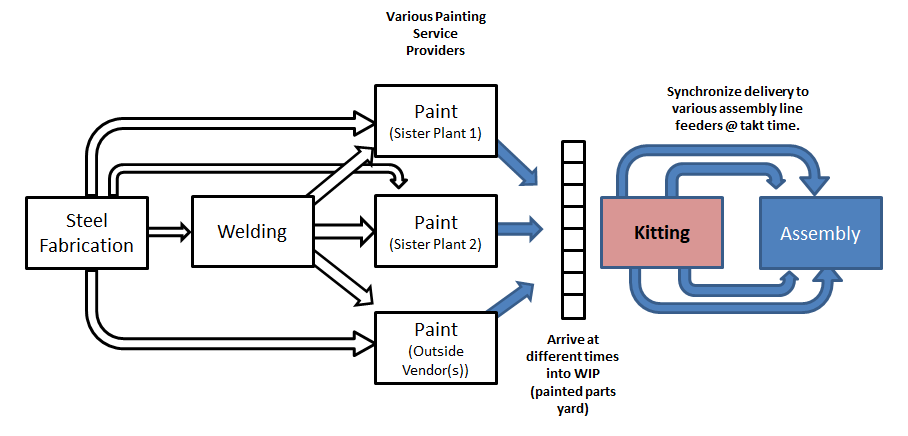
At a high level, the parts flow was supposed to work like this:

Steel parts are fabricated and welded, based on the production schedule for various configurations.

Unit sets of parts were sent to outside paint. (We didn’t have our own paint system yet.) In reality, unit sets would be broken up as some parts went to sister plants, others went to outside vendors, each with their own lead times and flow times.

Parts return from outside paint. Because of the different vendors and lead times, different parts arrive on different days.

On assembly day, kits are built for the parts required at each entry point on the assembly line. Those kits are delivered based on a pull. The assembly line had a number of entry points and feeders, so for each takt time cycle, though only one “unit’s worth” of parts were actually delivered, those parts were for different units, as feeders had different lead times into the main line.

image

The innocuous challenge was to develop the kitting process (in red) that broke down the parts into  kits and got them delivered to the line.

I got pulled in on Thursday of a “kaizen event” that was supposed to develop this process. What had actually happened, though, was analysis paralysis, a lot of theoretical discussions, a lot of drawings on a white board, but nothing had actually been tested or tried. My assignment was simple: Organize this and get it going on Monday.

I had four people working for me, though they were not officially direct reports. They were an eclectic mix of personalities and styles.

A few things became apparent very quickly:

The process of scheduling which parts needed to be fabricated and welded to be sent through painting on any particular day was broken. Result: What was needed wasn’t necessarily what got sent to paint.

The processes of keeping parts organized during the various outside paint operations was broken. Result: Unit sets got mixed together, parts went missing.

As a result this is what my days looked like:

I came in before a hint of dawn at 4:45am to prepare for the assembly line starting at 5:40. I would go out into the parts yard with the day’s production schedule and a flashlight. My goal was to answer a simple question:

What units on this list can I build with the parts that are here?

I would re-sequence the production schedule to front-load the units that looked like we had everything we needed. (This caused all kinds of problems with serial number sequences and engineering change control, but that is a different story.)

We would start pulling in those parts, and breaking them down into the kits. We set up FIFO lanes for each entry point on the assembly line, and worked as fast as we could to build up about a three hour backlog. Why? Because it took about three hours to expedite a missing part through paint. Once we had that queue built up, as we discovered shortages (or parts painted the wrong color!), we had a chance to get the situation corrected and have a shot at not creating a shortage on the line.

We were working 10 hour shifts, I was typically there for 12-14 hours. Even though I was a “lean guy” my daily work was orchestrating all of this chaos, expediting and delivering parts, and I spent at least six of those hours every day driving a forklift. I got really good at forktruck operation that summer.

At the end of the day, I might sit and chill for a little while, then would get in my truck, go home, and do it all again tomorrow. One of those days as I went to back out of the parking space, I hit the turn signal to put my stick-shift truck into reverse – because that’s how the forklift controls worked.

What I Learned

I actually continue to learn. But here are a few things that have stood out for me.

Shop Floor Production Supervisor is a really hard job. I wasn’t a supervisor, but I was doing many of the things that we asked supervisors to do. Making my people take their breaks. Slow down on the pallet jack. Listening to a frustrated guy who was ready to quit – understanding his paradigm, and helping him re-frame his experience. Constant radio calls to places in whatever building I wasn’t in at the time. Operating within a system that functions only with continuous intervention.

I totally knew how to set up a workable, stable process. I knew how to get all of these processes linked together to pull everything through. I knew how to build in effective quality checks.

What I was able to do was spend a few minutes at the end of my day, or during my lunch breaks (instead of eating) trying to implement some kind of simple visual control that mitigated against repeating a mistake we had just made. We attached a tag with a production sequence number (000 through 999, repeating) to each kit. That let us, and the people on the line, see if we had delivered something out of sequence.

Then, after I had delivered a yellow painted kit to go onto an otherwise blue painted unit (oops) we made a board with the production sequence numbers and the associated colors for the major components.

Then… after I had delivered (note the theme here) the wrong size of a major component to the line, we added that information to the board AND tagged those components so we could quickly distinguish one from the other.

But I was never able to address the upstream issues that were delivering short kits to us in the first place. All I could do was add steps, add time, add inventory to protect myself from those things and do my best to fix it before the main line got stopped.

We had a saying in the Army: “When you are up to your a$$ in alligators, it is hard to work on finding the best way to drain the swamp.”

Thus:

It is unreasonable to expect systems improvements when everyone is scrambling to make the system function at all. It isn’t that they don’t want to make improvements. It isn’t that they don’t know what to do. It is that there is barely time to breathe before the next problem needs to be stamped down.

And finally: A five person job requires five people. I had four people working for me. That wasn’t enough. Guess who had to fill in the rest of it? I tried my best to handle the problems so they could get into some kind of cadence on the stuff that wasn’t a problem. But (Routine+Problems) = (or greater than) 5 people in this case, and it took all of us just to navigate the rapids without dumping everyone out of the boat. If everything was running smoothly, it was probably a three person job. If we could have set up a sequenced pull from assembly all the way back through weld, it would have been a two or even one person job.

Reflection

That forklift key is still on the keyring in my pocket as a reminder of that time. What follows are some of the bigger-picture things that come to mind as I continue to construct, tear down and reconstruct my own thinking.

Attribution Error

There is a strong tendency among us humans to attribute our own failures to a poor environment, but to attribute other’s failings to individual character or capability. Yet in many cases, simply changing the venue or circumstances can allow a previously low-performer to blossom. We see this (and the opposite) all of the time in professional athletics.

Making this error is easy when we are talking about “they.”  If only they… Why don’t they… They don’t get it… “They” are people who are likely doing the very best they can within the context of the system they are in. And, as I pointed out above, changing the system from the inside is hard.

Actually that isn’t quite accurate. Changing the system is hard work.

The Pace of Change

The organization I was describing above was experiencing circumstances at the time that outpaced their ability to experiment, reflect, and adapt. Every organization has a rate at which they are able to change.

Just to make things more complicated, it is possible to learn what must be done much faster than those things can be put into place. This frustrates a lot of change agents. They see the technical changes that must take place, but often struggle against cultural barriers and obstacles. These things take much longer, and it is pretty much impossible to put them on a fixed timeline or project plan. Thus, we frame them as “resistance to change.” We know what must be done, but “they” don’t do it.

Organizations Under Stress

When an organization is under stress, there is fear of complete breakdown. People become very conservative and avoid the uncertain and unfamiliar. If they become overwhelmed just trying to get their task done, they are going to shut out any information that isn’t relevant right now. Horizontal communications break down, and the feeling of isolation increases.

At this point, all coordination has to funnel upward and then downward through the vertical linkages, as cross-functional coordination largely isn’t happening.

Now the higher leader gets overwhelmed, feeling she has to micro-manage every detail- because she does. “Why don’t they talk to each other?” Well, the structures for that were probably very informal, and now have broken down.

This Isn’t About “Them”

As I mentioned above, it is really easy to attribute the perception of dysfunction to individuals. And as people become isolated within their own task-worlds, avoiding a mistake becomes the dominate motivation. This happens even in organizations with the most benign intentions.

If you are a leader, pay attention to the emotions. If people are snippy, are pushing back on ideas as “just more work” then that saturation point may well have been reached. Pushing harder isn’t going to make things go faster, it is going to slow them down.

image

Creating Resistance As You Go (Don’t)

The role of “change agent” is actually a role of leadership.

Leading change is difficult work that involves changes in the norms, routines, working relationships, behavior within and between groups. It is required when a simple technical change either isn’t going to get the job done, or requires the above changes to work at all. Most (if not all!) of the “lean tools”* fall into the later: The process changes are straight forward, but making them work requires altering the habitual patterns of how people work together.

Before I dive into what works, I want to spend a little time on what doesn’t work.

The Bulldozer: Creating Resistance

Bulldozer climbing a mound of dirt.

A team had a challenge – the result they were striving to achieve – of getting a 2-3 week administrative workflow (that sometimes went longer) down to a consistent three days. Their target condition was a pretty good work flow that, by all accounts so far, could avoid a lot of delays (on the order of days and weeks).

The changes they proposed would eliminate a number of transfers from one department to another (which always means another queue). However it also calls for eliminating some long-standing work-arounds that involve filling out forms and passing them along by email. But now they have a new ERP system, and the intent has been that this work is done within that system.

Those forms are in another department’s process, and involve people who haven’t been involved (so far) with the work to date. (There are valid reasons for this, and yes, some of this could have been avoided by involving everyone from the beginning, but that isn’t the point of the story.)

A functional department manager set off a flurry of pushback through a series of emails that essentially said “This is the future” and exhorting people to get on board with the new process vs. defending the old one.

One of the tenants of an effective change agent is “Don’t work uphill” with the corollary of “Don’t create hills in front of you.” I call the opposite of this the bulldozer approach. Unfortunately, like the picture above, just trying to push things through tends to build up a mound of resistance in front of you.

What did we learn?

Rather than trying to engage the new idea as an experiment – “Let’s try this and see what we learn,” the change agent tried to use position power to push the idea through. He took an action, and had an (implied) expected result – that people would see the light and adopt the new process.. The actual result, though, was quite different than what was expected – they doubled down on their resistance.**

A scientific-thinking change agent (a.k.a “a leader”) is going to step back and assess. Why did I get the reaction I did? What triggered it? What are the values of this constituency that are being challenged? Most pushback comes from a perceived threat to something that is regarded as valuable.

Perhaps the current workflow solves a very real problem. Perhaps it is otherwise very useful for something I am not aware of. Or maybe there is some emotional stake attached to the status quo. There is likely a combination of all three, or other factors I haven’t mentioned.

When proposing a new idea there is an opportunity to become curious about what previously hidden (to us at least) obstacles have just been uncovered, step back and work on the next one.

Leadership is a series of experiments. Not everything will work. But everything is an opportunity for learning and adjusting or adapting the next step appropriately.

People who expect their position-power to carry them through often tend to assign blame to individuals as “resisting the change.” But if we carry a different assumption – that everyone is doing the best they can to do the best job they can – then we can reframe and possibly reinterpret the reaction we are getting.

What other interpretations could we assign to this pushback other than “They don’t want to?” How many of those interpretations can we think of?

What is your next step or experiment?

Each of those possible interpretations is a testable assumption. Now I can frame my next action, conversation, or intervention to test one or more of those assumptions. This requires me to go into curiosity mode, because I really don’t know if they are true or not.

Now I have a different conversation because I am seeking first to understand. I can test assumptions without threatening anyone. Listen. Don’t defend. Paraphrase back until you hear “That’s right” signaling agreement that you heard what they were saying. That doesn’t mean you agree, but that you heard. Until someone feels heard they aren’t going to be soaking in what you are trying to tell them, they are going to be setting up the next defense of their position.

There is VERY rarely a need to directly confront someone over a different interpretation of the facts.

Don’t be a bulldozer – it doesn’t work.

———–

*And Six Sigma tools, and Theory of Constraints tools, and TQM Tools, and the tools associated with pretty much any other “program” that falls under the umbrella of continuous improvement.

**Though, Dr. Phil’s coaching would probably be something along the lines of “What did you THINK would happen??” (Semi-apology to my non-US readers who may not have context for this attempt at cultural humor.)

Scientific Thinking vs. The Scientific Method

My recent post, “…but where is the problem solving?” stirred up quite a bit of conversation and traffic. I would like to dig a little deeper into what “good problem solving” actually looks and sounds like – beyond the forms and tools.

Underlying all good problem solving is scientific thinking. With it, I am constantly comparing what I think with what I observe, and looking at differences as evidence that what I think might need revision.

Some years ago, I was driving down a residential street in Rochester, New York, and observed a series of signs in a yard, each with a single number on them.

Huh… what are those? Maybe they are the house number. (Hypothesis) I checked the mailbox across the street, and saw the next number in sequence, the neighbor’s mailbox had the same as had the next number after that. (Devise a test of the hypothesis, run the experiment, gather evidence.) I concluded that, yes, the signs were indeed just the address displayed in a creative way, and continued my drive.

I didn’t run any formal experiments. I didn’t document anything. I didn’t go through “the five questions” – I just thought about what those numbers might be, and tested my thinking. Had the house numbers across the street been totally out of sequence, it would have remained a mystery, as my hypothesis would have failed.

Was I applying the scientific method? Not really. I applied all of those “hypothesis” terms after the fact as I wrote this. But at the time I was curious about something (the first step of science), and applied simple logic to test an assumption I had made. While it might not be “the scientific method,” I would contend this was “scientific thinking.”

Most of the time, that is my habit. When I am uncertain and curious about something, I check it out. I apply the same thinking pattern troubleshooting my computer when it does something surprising (or annoying – are you listening, Microsoft?). None of this rises to the level of formal experimentation, it is just methodical thinking.

More difficult problems require more rigor and structure. But many “problems” just require a pause, a little thought, trying something – followed by making sure it works – and moving on. It is the “making sure it works” part that many people leave out of this process. And it is “making sure it works” that raises a blind fire-and-forget action item into an experiment… assuming that if it doesn’t work, you then dig in to understand why.

Most of these things are quick and need little formal structure. People call them “applying common sense,” and I agree – as long as the experimental mindset is there.

Much like that previous post, some of us continuous improvement people have built specific expectations about what “problem solving” should look like. But, no matter what structure is applied, the underlying pattern of thought remains the same – even for casual troubleshooting.

It is this habitual pattern of thought that Mike Rother’s Toyota Kata is intended to teach through practice. He introduces structure, but any logically and consistently applied structure will work.

Let’s not confuse specific jargon or forms with our underlying intent: Learning to habitually glance across the street at a mailbox if you think those signs might just be the house number.