Toyota Kata: When to Switch Obstacles

Sometimes the situation arises where the learner has been beating her head against an obstacle with little or no luck overcoming it. The question comes up: When is it OK to give up and switch to something else.

The answer is, of course, a little situational. (Consultant speak: It depends…)

The natural progression of the Improvement Kata will provide an opportunity.
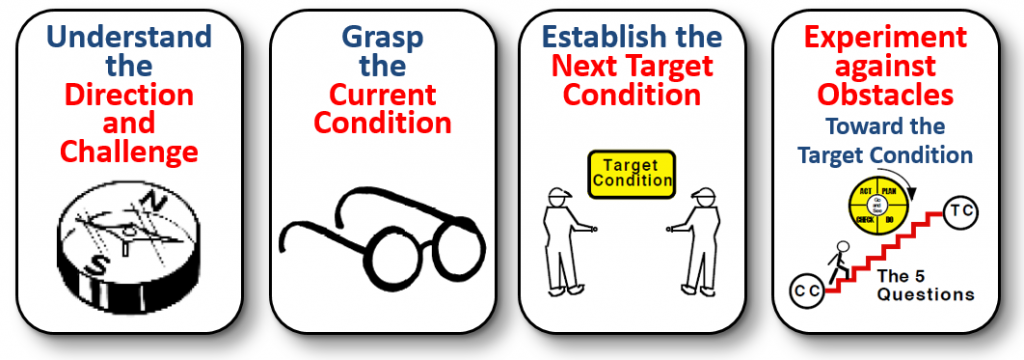
Improvement Kata steps by Mike Rother

As the learner is iterating against obstacles toward the Target Condition the clock is ticking because the Target Condition is always associated with an “achieve by” date. If the Target Condition is achieved OR we hit the “achieve by” date without achieving it, the learner should cycle back to the beginning and:

  • Verify understand of the direction and challenge. (The learner may well have gotten more clarity along the way.)
  • Get a complete grasp of the Current Condition. This is important because often while working toward a Target Condition the learner is only updating specific process and performance metrics, and may not be looking for collateral changes elsewhere. This is a time to take a step back, put up the periscope, and get a grasp of the complete picture.
  • Based on that new Current Condition, establish a new Target Condition, with a new “achieve by” date.
  • Now… identify the obstacles in the way of achieving that new Target Condition. Ideally they should wipe the obstacle parking lot clean and take a fresh look.

This process often helps clear the learner’s mind and see another way to get there, or see easier obstacles that were overlooked before.

This is also why it is important for the “achieve by” date to be relatively close (a couple of weeks) – because that date is a safety valve that forces a reset of the process if the learner is stuck.

If the learner asks if it is OK to work on a different obstacle, then the coach should become curious about the learner’s rationale.

Specifically, I want to understand why the learner thinks there might be an easier way vs. just saying this one is too hard. This may well require some more information gathering – a mini version of the reset I talked about above.

The key point here is to maintain the learner’s motivation. There is a fine line between struggling to solve a problem and getting frustrated. This might be a good time for the coach to engage in some empathetic questioning.

For example, name the feeling you are picking up to test your hypothesis: “It seems you are really frustrated by this…” Then listen. The learner will likely either agree, “yeah, I am.” or refute and give you more information, “No, I’m just trying to…” Then you might learn more about their threshold of knowledge with the process of problem solving.

That can open up a discussion for why the learner thinks it would be a good idea to try something else. Then use your judgement.

But as a coach, I don’t want to make switching obstacles too easy because there is a high risk of it becoming a whack-a-mole game. Some obstacles actually require digging and perseverance to overcome. Your job, coach, is to keep the learner in the game.

Sometimes, though, the learner gets fixated on a problem and doesn’t see another way. Even in this case, if the time to the “achieve by” date is short, I’d let it ride. But if that isn’t practical…

The coach may well have a broader perspective – in fact, this is part of the coach’s job.

If the learner is making progress on something I (the coach) consider a red herring, I generally let it go. There is always learning involved – so long as the effort doesn’t bog down progress.

Sometimes, though, the learner is getting frustrated and so focused that he just doesn’t see any other way.

This is time for gentle intervention with whatever questions might help the learner pause, step back, and see the bigger picture.

For example, perhaps something like “If this obstacle were cleared, how would the process operate?” This might not be the full target condition. I’m just trying to learn what “solved” looks like to the learner. Maybe just thinking about it will help them see the where they are trying to go and possibly another path to get there.

An interesting follow-up might be, “Hmmm, what’s stopping it from working that way now?”

“What would you need to learn to better understand what is going on?” might be another avenue to get the learner to look at his threshold of knowledge vs. the big ugly obstacle in front of him

It all depends on what you think will help the learner raise her head and take a different look at things.

But in the end, if you have a learner that is truly stuck, and after a few tries isn’t going to get unstuck, then, honestly, it’s time to go shoulder-to-shoulder with them and dig into things together.

What I would work very hard to avoid is direct intervention – “Why don’t you work on…” because this undermines the entire process by giving them the answers and can easily create a “what do you think I should work on?” expectation next time.
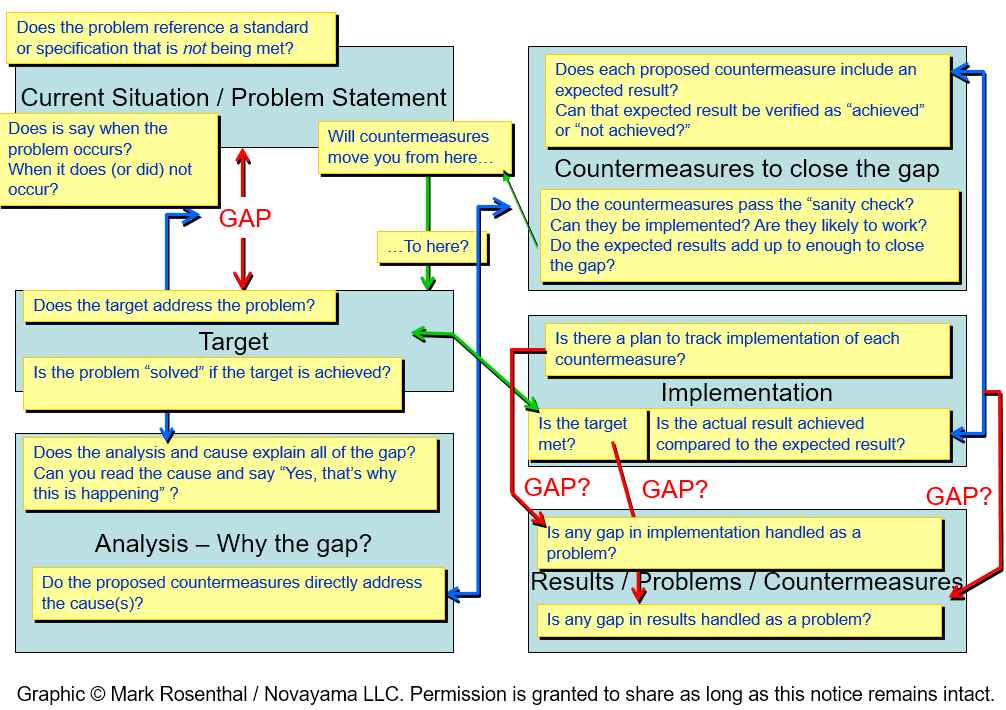
“A3” is an Obligation for the Coach

In Western business it is pretty typical for someone to be assigned to come up with a proposed solution to a problem, and then seek approval for that solution. In some companies that consider themselves more forward thinking, they might even say something like “bring me an A3.”

As a result I have seen a number of organizations that produce some kind of guideline for “how to fill out and A3.” They teach “problem solving” courses so people can learn to do this properly. I have developed, and delivered, a couple of those back when I was working in internal continuous improvement offices. We had case studies, exercises, all in an effort to teach people to be better problem solvers.

Similarly, a (very) long time ago, I recall an exchange on an online “lean” forum where someone had asked about Toyota’s “problem solving class.” The thought was that because Toyota has good problem solvers, that their course must be really good.

My response was that I have a copy of Toyota teaching materials for a problem solving course. It is good, but nothing magical. Because that isn’t how Toyota develops good problem solvers.

They do it with coaching.

What makes the “A3” process work isn’t the A3, or even the structure. It isn’t the instructions, guidelines, or the quality of the problem solving classes.

It is the almost continuous interaction between the problem solver and the coach.

The problem solver’s thinking is challenged. “What evidence do you have?” “Have you tested that assumption?” “How is that happening?” “Why do you think that is the problem?” “What are you planning for your next step?” “What do you expect to learn?”

And it is the coach’s stubborn refusal to give the problem solver the answer. Rather, they insist on following the rigor of the problem solving process using scientific thinking.*

The process is an application of the principle of “Challenge” followed by support to enable the problem solver / learner to meet the challenge. They have to bring perseverance to to the table, but the coach is there to make sure they actually learn to be better problem solvers in the process.

Likely (if you are reading this) you already know that. We knew that when we worked so hard to make those A3 guidelines and problem solving courses. But we did those things anyway.

Why? Because it is easier to develop and deliver those general class materials than it is to develop managers into coaches and leaders.

But the fact remains:

If you want to develop better problem solvers, what you need are better coaches.

The implications here are really profound for most organizations.

If you assign someone to solve a problem, to “do an A3” (or whatever structure you use), you are obligating yourself to coach them through the process.

This is far more than getting status updates. And it is far more work. Because you are teaching, not just supervising. If they fail, it’s on you, not them. “If the student hasn’t learned, the teacher hasn’t taught.”

In Toyota Kata world we have reduced those questions down to the critical few in the Coaching Kata. That, of course, is a start. Your job as a leader is to practice until the flow of the logic is second nature to you, until you can go beyond the script. Until your first-nature, reflexive response to anyone proposing to do something is “What problem are you trying to solve?” or “What are you trying to learn?” and then carefully listening to their logic and pushing them to the edge of their ability with the next step.

When you can take your own coaching training wheels off, you can then (and only then) ask someone else to ride a bicycle for you, because you will know how to teach them to ride – and that involves more than sending them to a PowerPoint lecture on “Riding a Bicycle.”

“Because knowledge is not understanding” – Destin Sandlin.

———

*Some years ago I worked briefly with a manager who had been one of the key players in Toyota’s initial startup of their plant in Kentucky (TMMK). He told me an interesting story. In the beginning, he noted, the U.S. managers would go to their coordinators (Japanese Toyota senior leaders there to advise the new team) and ask for advice.

Then one week all of the U.S. team went through the problem solving / A3 course. The following Monday, he went to his coordinator with a question, and the response was “Doug-san, where is your A3?” After that day, the coordinators would not engage unless there was an A3 that outlined, in writing, what the manager already understood about the problem, what he was seeking to learn, and how he proposed to go about learning it.

Think about that story vs. sending people to “problem solving class” or even a “Toyota Kata” class. When they return, do you insist that they apply what they have learned whenever it is appropriate from that day forward? If you don’t then you are wasting their time and your money sending them to that class. They will never develop the skill without practice, and it is always easier not to practice something we are not comfortable doing.

Daily Management for Improvement

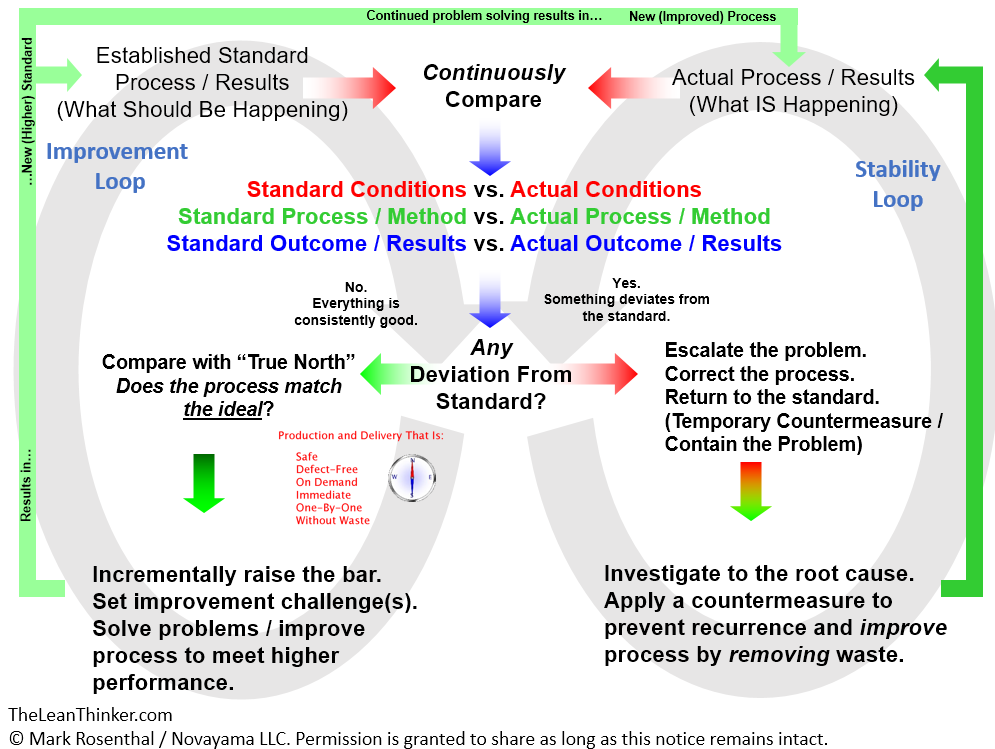
I’m digging through old archives again, and came across this graphic I put together around 2006 or so. It depicts more detailed version of “Organize, Standardize, Stabilize, Optimize” showing the continuous comparison between “what should be happening” and “what is actually happening.” It is the gap between these two that drives improvement forward.

Like the pocket card in the last post, this is built on a foundation established by the work of Steven Spear, especially his PhD dissertation that is summarized in Decoding the DNA of the Toyota Production System. By the way, if you are in the business of continuous improvement, reading (and understanding) this breakthrough work is critical for you.

Other than generally sharing this, my other reason for putting this up is that in the Toyota Kata community there has been discussion for about a decade about whether or not the right hand loop – pushing for stability – is an appropriate use of the Improvement Kata.

I think that is an unfortunate result of some very early conversations about the difference between “troubleshooting” and “improving” a process. We get into semantic arguments about “problem solving” as somehow different from “root cause analysis” and how the Improvement Kata is somehow distinct, again, from those activities.

This makes no sense to me for a couple of reasons.

Scientific Thinking is the Foundation

Toyota Kata is not a problem solving tool. It is a teaching method for teaching scientific thinking, and it is a teaching method for learning to teach scientific thinking. In the books and most literature, it uses organizational processes as working examples for the “starter kata,” but exactly the same thinking structure works for such diverse things as working through quality issues, developing entirely new products and processes, working through leadership and people issues. The underlying sub-structures may change, but the basic steps are the same.

When I encounter an organization that already has a “standard problem solving approach” I do not attempt to tell them they are wrong or confuse them by introducing a different structure. Rather, I adapt the Improvement and Coaching Kata to align with their existing jargon and language, and help them learn to go deeper and more thoroughly into their existing process.

Stability is a Target Condition

I see a lot of pushback about working to “return a process to standard.” In reality, that is the bulk of the activity in day-to-day improvement. The whole point of having a standard in the first place is to be able to see when the actual process or result is somehow different.

Think about it: If there isn’t an active means of comparing “actual” vs. “standard” what is the point of having a standard in the first place?

Think of the standard as a target condtion.

What obstacles are preventing you from [operating to that standard]? You can guess, but the best way is to diligently try to operate to the target condition and see what gets in your way. That might not happen immediately. Maybe some time will go by, then BAM! You get a surprise.

This is good. You have learned. Something you didn’t expect has interfered with getting things done the way you wanted to. Time to dig in and learn what happened.

Maybe there was some condition that you could have detected earlier and gotten out in front of. Who knows?

This is all part of the continuum of Troubleshooting by Defining Standards.

You Cannot Meet a Challenge Without Working on Stability

As you are working to reach new level of performance – working toward a new challenge – there will be a point when the process works sometimes, so you know it is possible. But it doesn’t work every time because there are still intermittent obstacles that get in the way.

Nevertheless, you have to work diligently to see problems as they occur, respond to them, dig into causes (root cause analysis anyone?) and systematically protect your process from those issues.

The only real difference between covering this territory for the first time vs. trying to recover a previously stable process is that in the later case you can ask “What has changed?”

But, in the end, in both cases – stabilizing a new process vs. re-stabilizing an old one – you are dealing with conditions that are changing from one run to the next. That is why it works sometimes and not others. You don’t know what is changing. You are trying to figure it out by experimenting and learning.

What About Root Cause Analysis?

My challenge is still a stable process.

My current condition is my level of understanding of how the process works today, and the exact mechanism that results in a defect. Even defects are produced by a process – just not the process we want.

That understanding will be incomplete by definition – because if we truly understood what was going on we wouldn’t have the problem. So… what do I know (and can prove with evidence) and what do I not know.

What do I suspect? What evidence do I need to gather to rule out this possible cause, or keep it in play? Next experiment. What do I expect to learn?

I’ll write a more detailed post about this at some point. I think it is a topic worth digging into. Suffice it to say that I have absolutely used the Improvement Kata structure to coach people through finding the root cause of wicked quality problems.

It really helped that they were able to see the same underlying pattern that I had already been teaching them. It made things simpler.

Don’t Complicate a Simple Concept

It’s all “solving problems” (the term “problem solving” apparently has some specific form it needs to take for some people).

The underlying structure for all of it is scientific thinking. Some say it’s PDCA / PDSA. Same thing.

Splitting semantic hairs and saying “this is different” makes simple things complicated. Yes, there are advanced tools that you use when things get tough. But… addition and subtraction; basic algebra; advanced polynomials; basic differential calculus; advanced multivariate calculus – IT IS ALL MATH. You apply the math you must to model and solve the problem at hand.

DON’T apply more math than you need just because you can. That serves no purpose except, perhaps, to prove how smart you are… to nobody in particular.

Solving problems is the same. There are some cases where I need to develop a designed experiment to better understand the current condition – the interactions between variables. There are cases where other statistical tools are needed. Use them when you must, but not just because you can.

Use the simplest method that works.