Takt Time: Let’s Do Somebody’s Homework

On the back end of this site, I see the search terms that landed people here. This one showed up yesterday:

"a packaging process works two, 8 hour shifts per day. there are two 15 minutes breaks per shift. daily production requirements are 240 packed units, with a planned machine down time of 30 mins per shift, team has to work 60 mins overtime per shift, it is a 4 member team – calculate takt time"

OK, readers, let’s help him out. What’s the answer?

Why is this phrasing ambiguous if the author of the question is looking for a “right” answer?

Toyota Kata “A3 Problem Solving”

Over the years, I’ve been exposed a number of efforts to “implement A3 problem solving” in various companies. I worked for some of those companies, I’ve observed others.

The results are nearly always the same.

Here are a couple of examples. Let me know if any of these match up with experiences you have had.

Example 1: The company had put many people through “Practical Problem Solving” training and was (ironically) trying to measure how many problem solving efforts were underway.

I was watching a presentation by one of these problem solving teams to management. Their A3 was on a computer, projected onto the screen. They were reporting their “results.” Yet there were large discontinuities in their problem solving flow. The actions they were taking simply did not link back (through any kind of identifiable cause) to the problem they were solving.

The management team listened carefully, applauded their efforts, and moved on to the next topic of their meeting.

Example 2: A different company had a form to fill out called an “MBF” or “Management by Fact.” From the labels on the boxes, it was clearly intended to be structured problem solving. By the time I worked there, however, “MBF” had become a verb. It was a solo activity, filling out the form at the desk, and reporting on it in a staff meeting.

Example 3: Well-meaning former Toyota team members, now working for a different large company wanted to “train everyone in problem solving.” They put together a “class” that presented the purpose of each block on their A3 form with the expectation that people would adopt the process.

All of these efforts had something in common.

They didn’t work.

Over the last few days, I’ve been privileged to be included in an email exchange about the relationship between A3 and Mike Rother’s Toyota Kata. My small contribution was apparently enough to get my name onto the cover, but I want to give a real nod in the direction of a Jenny Snow-Boscolo for instigating inspiring a really good exchange.

The result is here. I think this presentation does a really good job of summing up the relationship between Toyota Kata and Toyota A3. Thanks to Mike Rother for taking the initiative and putting it all together (more below)

One of the difficulties with gaining insight into Toyota’s management processes is that they really aren’t codified. This shouldn’t be a surprise. Look at your own company, and ask how much of the culture – the reflexive way things are done and interactions are structured – is written down.

(In fact, if it is written down, I would contend it is likely your actual culture has little resemblance to what is written about it. Those things tend to be more about what they wish the culture was.)

Culture, any culture, is learned through daily interaction. This is all well and good in cases where people are immersed in it from the beginning.

But the rest of us aren’t operating in that problem solving culture. Rather, we are trying to create it. And as the former Toyota Team Members from Example 3 (above) learned, it isn’t a simple matter of showing people.

Rather than two different things, we are looking at a continuum here. At one end is the culture described on Slide 9. There isn’t any formal structure to it, the process for teaching it isn’t codified. It is learned the same way you learn the way to get the job done in any company. They just learn different things than you did.

But in another organization there is no immersion. If there is anyone who is steeped in The Way, they are few and far between.

In these cases, we want to start with something more overt. And that is the purpose of having a rote drill or kata. It isn’t something you implement. It is a structure, or scaffold, to learn the basic moves. Just as mastering the musical scales is only a prelude to learning to play the instrument, the kata is the foundational structure for learning to apply the underlying thinking patterns.

So… if you are working on kata, it is critical that you are reflecting on your thinking patterns as much (or more) than you are reflecting on your improvements. It might seem rote and even busywork at first. But it is there to build a foundation.

Navigating the Learning Hairball

Credit: A lot of stuff comes across my screen, sometimes more than once. I have seen this illustration several times, but don’t remember where it originally came from. If you created it, PLEASE comment so I can give appropriate credit.

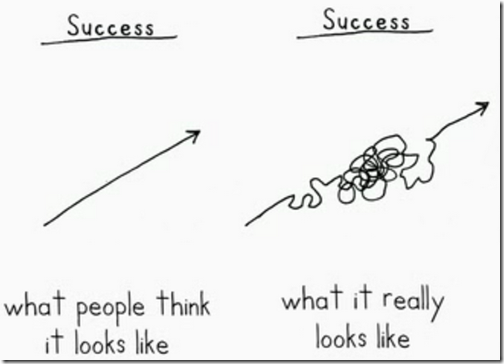
Improvement is messy. Science is messy. Research and Development is messy. These are all cases where we want an outcome, are pretty sure what that outcome looks like, but there isn’t really a clear path to get there.

This illustration has illustrates two very different mindsets.

On the left is how many people believe the improvement / organizational development / learning process works. We set out a phased project plan to transform the organization. We carry out a set of pre-defined steps, and when they are completed, we are at the goal.

Sadly our education process is largely constructed on this model. Take the classes, pass the tests, the student is educated.

This thinking is appropriate when the outcome is something we have done before, like constructing a house. Even if this house is a bit different, the builders have rich experience in carrying out all of the constituent process steps. Further upstream, the designer carefully followed building and construction codes. In those cases, we are applying a rich body of experience (or the documented experiences of others) to reach the end goal.

These tasks can be scheduled and sequenced in a project plan. The steps are known, the result is known.
 

image

On the right is the hairball of learning and discovery.

We know where we are starting.

We know where we want to end up.

We are reasonably certain we can get from Point A to Point B. But we don’t know precisely which detailed steps or experiments will give us the results we need.

We don’t know for sure that the next result will be a forgone conclusion from the next action step.

Each step gives us more information about the next step.

In the world of continuous improvement, we live in an interesting paradox.

We often believe we are operating in the set-piece model on the left. We see a situation, we apply tools to duplicate a solution we have seen work in a similar situation before.

An interesting thing happens at this point. The Real World intervenes, and we discover that the situation was actually more like the right side. We thought we knew the right answers. We might have even been mostly right. But at the detail level, things don’t work quite as we predicted.

Now… if the system has been deliberately set up to flag those anomalies, and we are recording them and being curious to discover what we didn’t understand then we are in learning mode.

But all too often the experts who guided the original installation have moved on, leaving the people executing the process behind. The assumption was “It works, we can go to the next problem.”

The people in the process did what they were told, or guided, to do. We might have even asked for their input on the details. But that process rarely leaves them with additional skills they need to deal with anomalies in ways that make the process more robust.

So they do what they must to get things done. Mostly that means adding some inventory here, some additional checks or process steps there. Over time, the process erodes back to something close to its original state.

Why? Because we thought we knew everything… but were wrong. And didn’t notice.

This model applies to any effort to shift how an organization performs and interacts. We outrun our headlights and take on the Big Change because that company “over there” does it, and we just copy the end result.

What we missed was doing the work.

More about this later.
Standards: Notes On A Whiteboard

image

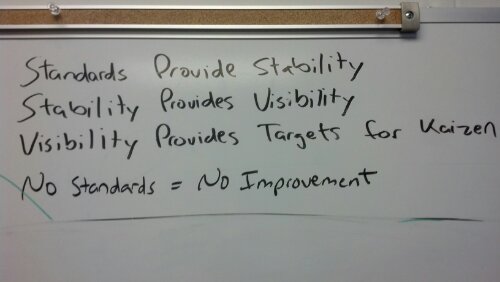
I saw this on a client’s whiteboard this morning. (Actually I saw it a while ago, but just took the photo.)

By having a clear expectation about what is supposed to happen, they can work to converge the process toward some kind of consistency. The opposite is just accepting whatever happens as OK.

By having a degree of stability, it is easier to see issues and opportunities, that in turn, allow them to set the next level of standard.

He put it up there to remind him when he is distracted in the day-to-day fray that “What are we trying to achieve?” is the important first question to ask.

Remember, there is no dogma. Your choice of words and definitions may vary. But these work for him.

…And we’re back

Some of you likely noticed the site was down for about 12 hours over Jan 2/3.

I had been the target of a “brute force” attack to attempt to login to the site administration, presumably to install malicious scripts, etc.

The attack was not successful, however it did consume all of the CPU cycles of my host’s server, so they shut off access to the site.

I have installed countermeasures, none of which are visible to readers.

It’s the wild west out there.