Coaching with Intent

As I continue to explore the concepts in David Marquet’s Turn the Ship Around, I am finding increasing resonance with the concept of intent. I’d like to explore some of that in relationship to lean, “Toyota Kata” and organizational alignment.

For a quick review, take a look at the sketchcast video, below, and focus on the part where he talks about “we replaced it with intent.”

I think the critical words are “You give intent to them, and they give intent to you.”

Think about that phrase, then think about how we normally talk about “intent.”

OK, are you back?

In my experience, “intent” has traditionally been a one-way communication. “This is what we need to get done.”

A few months ago I was in a plant, discussing this principle. One of the managers expressed frustration saying “I think I was very clear about what I expected…” (And he was) “but then when I checked he had done something totally different. How does this work for that situation?”

What was left out of that conversation?

…and they give intent to you.

Let’s put this in Toyota Kata terms.

What is the relationship between the “Challenge” and the “Target Condition?”

Think about how the target condition is developed.

Start with the challenge – this is the level of performance we are trying to achieve – the “mission” in military terms, the overall intent of what we are trying to get done.

Once the direction and challenge (the intent) are understood, the improver / learner’s next task is to get a thorough understanding of the current condition. How does the process operate today? What is the normal pattern? Why does it perform the way it does? This should be focused in context of the direction / challenge / intent.

Then the learner (NOT the coach!) proposes the next target condition.

Depending on the level of skill in the learner, the coach may well be assisting in developing all of this, but it is the learner’s responsibility to do it.

Imagine this conversation: as the learner / improver is discussing the target condition, he relates it back to the challenge as a verification for context.

“The overall challenge we have is to _______. As my first (next) target condition, I intend to _____ (as the learner relates his next level of performance, and what the process will have to look like to get there).

Adding the words “I intend to…” to that exchange has (for me) proven to be a powerful tool when learners are struggling to embrace / own their target conditions. Those words establish psychological ownership vs. seeking permission.

The same structure can be applied to the next step or experiment.

“What is your next step or experiment?”

I intend to (fill in your experiment here).”

Going back to the sketchcast video, remember the part where he says:

“Captain, I intend to submerge the ship.”

“What do you think I’m thinking right now?”

“Uh…. hard to tell… I’m guessing you want to know if it’s safe.”

“BINGO! Convince me it’s safe.”

“Captain, I intend to submerge the ship. All men are below. All hatches are shut. The ship’s rigged for diving. We’ve checked the bottom depth. We’re in the water that’s assigned to us.”

In not only stating intent, but going through the checklist, the “learner” demonstrates that the intent will be carried out competently, or not.

We are asking the same questions when we ask about the next experiment, what outcome is expected. Logical follow-on questions could include seeking assurance that the experiment actually addresses the stated “one obstacle” being addressed (this is the right thing to do) and that learner has a plan to carry out the experiment that makes sense, knows what information he intends to collect, what observations he needs to make, and how he intends to do these things (that it is being done competently).

At an advanced level, a good answer to “What is your next step or experiment?” could (should!) include all of these elements – enough information to convince the coach that it is a good experiment, seeking the right information, in the right way.

It becomes  “to address that obstacle, I next I intend to (take these steps, in this way, with these people) so that (fill in expected outcome). I intend to measure here and here, and verify my results by…”

Of course as a coach, if you have a learner who is unsure how to proceed, or looking to be told what to do (which is quite common in organizations that have to overcome a command structure where the boss is the problem solver), how do you need to phrase your coaching questions to get the next level of responsible language out of your learner’s mouth?

If they are waiting to be told what to do, how do you get them to offer an opinion?

If they are offering an opinion, how do you get them to offer a recommendation? Is it well thought out? “What result do you expect?” “How do you expect to achieve that result?”

If they are offering a well thought out recommendation, how do you get them to express an intent? What do you have to hear to be convinced that intent is well though out?

I want to be clear: This is advanced stuff, but it goes hand-in-glove with the coaching kata.

And, to give credit where credit is due, it is all the work of David Marquet. I am just adapting it to the kata here.
Often Skipped: Understand the Challenge and Direction

I’ve been practicing, teaching (and learning) the Toyota Kata for about four years now, and I’m seeing some pervasive patterns that are getting in people’s way of making it work.

The one I’d like to address today is skipping over “Understand the Direction.”

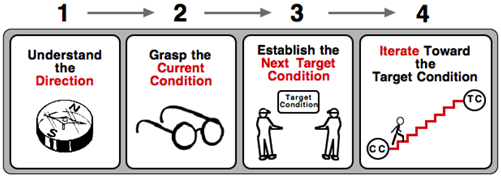
As designed by Mike Rother, the Improvement Kata has four basic steps:

image

Graphic © Mike Rother  (click on the graphic to download the Improvement Kata Handbook)

This fact (that there are four steps) is often lost on beginning practitioners. They tend to associate “Toyota Kata” only with the “Five Questions” of the Coaching Kata, which guide Step 4 (above). On the surface, that is understandable, because we hear the coaching cycles a lot more frequently, and they are a hallmark of the kata principle.

But we (hopefully) wouldn’t think of jumping right into the Five Questions until the answer to “What is your target condition?” is something more definitive than “To improve this process.”  (We only used to do that, right? hmmm.)

One of the reasons to set a clear target condition is to get away from general “waste safari” improvement efforts, and focus the improver’s attention on what must be done to get to the next level.

Without a sense of direction, it is easy for the improver to see every improvement opportunity (or none of them), and get locked up trying to find a way to fix them all.

It’s frustrating for everyone, because little progress is made, and those improvements that are made have a tough time finding their way to any higher level meaning.

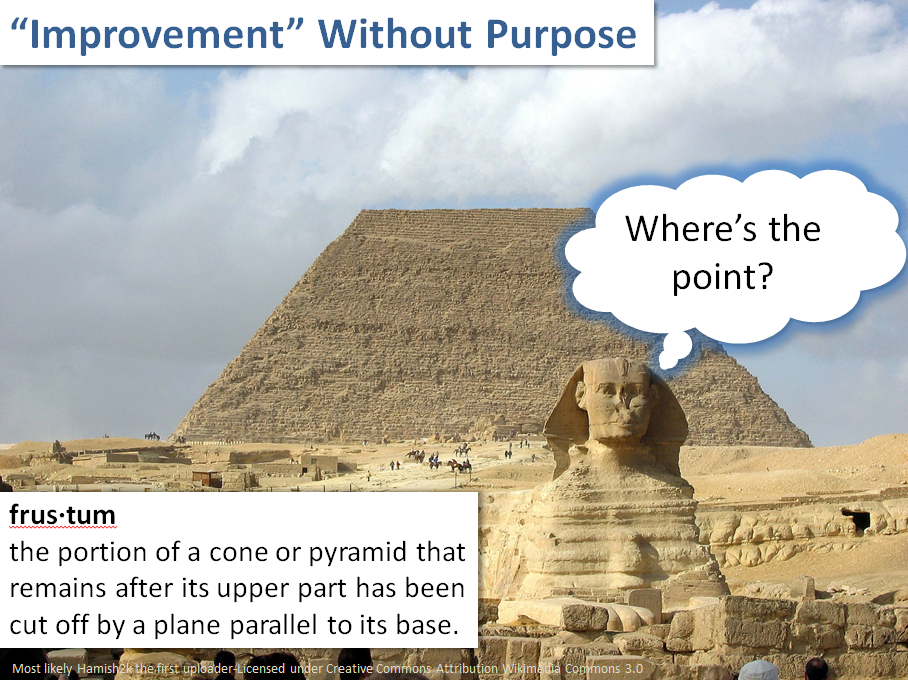
Someone, long ago, pointed out to me that the geometric figure “frustum” seems to have the same Latin root as “frustration.” This is the graphic that comes to mind:

image

Though the concept of a clear target condition is fairly easy to get across, organizations seem to get locked into a cycle of Steps 2, 3 and 4 without ever going back to Step 1, except in the most general terms.

Here’s what I think happens:

When an organization is just getting started, we’ve commonly told them to pick an area to practice, based on quick cycles and other practice criteria, and get to learning the improvement kata, striving toward a general challenge like one-by-one flow.

That pattern of seeking improvement opportunities gets engrained, and it is hard to shift off it and start to set clear direction and challenges. Further, it is very similar to the “old way” of planning kaizen events where the goal is to “implement lean tools” … like one-by-one flow.

Setting that direction also seems to run counter to the idea of empowered workers are in the best position to know what to work on. (It doesn’t, in fact direction is required for this to really take hold.)

In another sense, though, the Challenge for one level is, in reality, the Target Condition (or at least a major obstacle) for the level above. If I am asking the VP-Operations what his target condition is, I am going to hear things that sound a whole lot like a Challenge for the next level down.

And if the senior leaders don’t have a clear sense of where they are trying to take the organization next… what is their scope of their responsibility?

What to do differently?

(It might help if the leadership team themselves got a coach.)

1) Be clear that your initial sessions are practice drills. You are not yet playing the game, or even a scrimmage. You are flipping tires. Be conscious that this is a transitory learning stage.

2) Establish a target condition for proficiency you are striving for in your practice. Check it weekly against your current condition. This is the job of the advance / steering team.

Challenge Light

For the first pass, it isn’t necessary to dig headlong into hoshin planning, and in many cases, you can issue a compelling challenge with a theme.

Look at what is bugging your customers about your current operation, and challenge yourself to fix it.

For example, one client had lead times and response times that were getting longer and longer, so the challenges issued by the leadership team revolved around lead time and removing “sources of delay.”

Another company had rework and quality escapes going out of control. Their first step was to “grasp the current condition” and identify where these problems were happening.

image

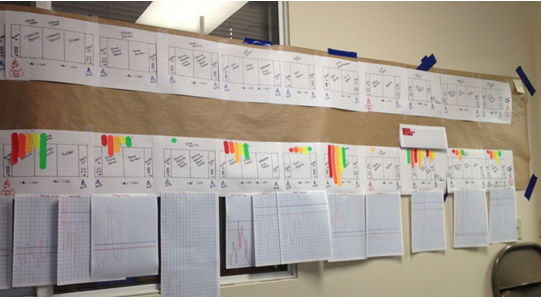
Each dot represents the origin of a defect or rework. (The colors don’t mean anything, they ran out of red, then orange, then yellow dots.) (You can see exit cycle run charts taped up there as well.)

This gave them a quick picture of where to focus their attention, and which leaders they needed to challenge, and then coach, through the process of improving their quality.

Note that for these guys, integrating the flow of material and information though the plant isn’t a target condition, or even a challenge yet. It is in the vision, but the first priority is simply to ship what the customer ordered, and then to only make the product once to do so.

By the way, profit is measurably up, rework instances have been cut by about 3/4 from the starting point, and they are well on their way.

Competence and Clarity: Toyota Kata at Sea

A friend, and reader, Craig sent a really interesting email:

As I was practicing the coaching Kata with one of the First Mates on the factory trawler, whenever an issue arose (usually with the leader blaming an employee) he began asking factory and engineering leadership “what needed to be communicated?” or “what needed to be taught?” He found it encompassed every problem on the vessel and I loved that he made it his own and communicated in manner to which lifetime fishermen could relate.

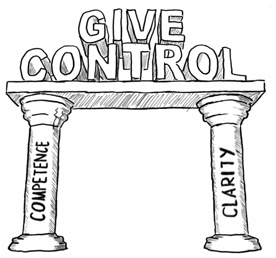
What I found really cool about this is how it is exactly the same conclusion reached by David Marquet, both in the sketchcast video I posted earlier, and the titles of two chapters in his book. The reasons leaders feel they must withhold authority, remain “in control” ultimately come down to competence – what must people be taught, or clarity – what have we failed to adequately communicate. Maybe it’s being at sea.

In other words, if people know whGiveControl.pngat to do (clarity), and know how to do it (competence), then leaders generally have no issues trusting that the right people will do the right things the right way.

The Improvement Kata  is a great structure for creating and carrying out development plans for leaders (or future leaders) in your organization.

The Coaching Kata is a great way to structure your next conversation to (1) ensure clarity of intent: Does their target condition align with the direction and challenge? and (2) develop their competence, both in improving / problem solving, but also in their understanding of the domain of work at hand.


David Marquet: Turn The Ship Around

A while back, Mike Rother sent around a link to a sketchcast video of a U.S. Navy submarine skipper talking about the culture change aboard his submarine, the USS Santa Fe. I posted and commented on it below, in “Creating an Empowered Team.” If you haven’t watched it, do so now so you have context for the rest of this post.

Since then, I found other presentations by Capt Marquet (pronounced, I have learned, “mar-kay”), read every post on his blog, then bought and read his book Turn the Ship Around.

His message is compelling, and I have been digesting and integrating it for a couple of months now.

The Empowerment Movement

Back in the late 80’s and early 90’s there was a big push for “empowerment” and the idea of “self directed work teams.”

Supervisors and managers were re-titled as “coaches.”

Work teams were told they were expected to self-organize to accomplish the work at hand.

I suspect this was yet another case of “benchmark and copy” – observing the attributes of high-performance organizations and trying get the same results by duplicating the description. “They have self-directed work teams, so let’s tell our work teams to self-direct.”

In the classic words of Dr Phil… “How’s that workin’ for ya?”

I have worked with, and in, a few organizations with a very bad taste for their past experiments with “empowerment.”

The Difference between “Involved” and “Committed” Leadership

Obviously some organizations have succeeded at creating work environments where work teams know what has to be done and do it. If that weren’t the case, there wouldn’t have been anyone to benchmark and copy.

Capt Marquet’s book gives us a first experience account of a leader who resolved to change the climate of his organization. Admittedly, he did so out of perceived necessity. (Read the book to get the full story!)

Today, though, when leaders say they are “committed” they usually mean they are willing to fund an effort, allow someone else to carry it out, get updates, and give encouragement. That might work for starting a subsidiary, but it doesn’t work for changing “how things get done.”

What we are talking about here is developing the competence and capability of the organization, step by step, individual by individual, as the primary daily work of leadership.

Capt Marquet describes his struggles, setbacks, how hard it was at times, and the long-term reward of his efforts – unprecedented promotion rates or personal successes among his former officers and crew in the 10 years following his time in command. His primary role was developing people. They happened to be the crew of a nuclear powered submarine.

Over the next few posts, I am going to explore the correlation between David Marquet’s leadership development model and Toyota Kata. Stay tuned.

In the meantime, read the book. It’s an easy read and worth your time.

Mike Rother Overview of Toyota Kata

This is a 5 minute edit of the presentation Mike Rother made at the UK Lean summit.

It is a succinct summary of interaction between a coach (leader) and learner (someone working on improving a process).

My thoughts are below the video…

OK – here are some things I have learned with these methods “in the wild.”

Most organizations I have been working with can’t take on 1-3 year challenges and stay the course for that duration. The horizons are too far for them to see what is possible within that kind of time frame and stay the course.

I have been trying 3-4 month time horizons for initial challenges in organizations where everyone is learning the basics at all levels. That gives them an opportunity to practice with a horizon that is less likely to be derailed by a sudden change in direction during that time. Eventually, as they develop capability, they can extend the time horizon and morph these practice challenges into something more formal, linked to the business plan.

Middle managers like to leap onto the coaching questions much too early – before they are capable of actually coaching. The coaching questions are seductive because they are written down and structured.

The PDCA process is much more nuanced, but it must be mastered before attempting to coach. Why? Because the coaching process is application of PDCA toward the learner’s development.

While it is OK to round-robin coaching and actual process improvement, everyone has to work together to reflect and learn.

In addition, those middle managers tend to try to leap into coaching before they have an internally set non-negotiable sense of “True North” – driving toward better and better flow.

When a middle manager is taking on the role of the “learner” there is a great temptation for him to delegate tasks to others, and get reports. This is status quo, and does nothing at all to develop capability.

Like everything else we do in the West, or at least in the USA, we try to get there fast by skipping the basics.

Make no mistake – you don’t “implement Toyota Kata.”

You use it as a structure to build foundational capability and new thinking patterns.

Those patterns are only developed through practice, and deliberate reflection on the management process itself.

I have also seen an organization that is “getting it” pretty quickly. The difference is that they are all overtly in “we are just learning this” mode, and willing to make mistakes and learn from them vs. trying to appear to be competent from the get-go.

Mike Rother has other videos on YouTube as 734Mike.

“True North” – Explicit or Intrinsic?

compassOne of the factors common to organizations that maintain a continuous improvement culture is leadership alignment on an overall direction for improvement – a “True North” – that defines the perfection you are striving for.

Steve Spear describes Toyota’s “Ideal” as:

An activity or a system of activities is IDEAL if it always produces and delivers:

(a) defect-free responses (those that meet the customer’s expectations),

(b) on-demand (only when triggered by the customer’s request),

(c) in batches of one,

(d) with immediate response times,

(e) without waste, and

(f) with physical, emotional, and professional safety for the supplier.

(From The Toyota Production System: An Example of Managing Complex Social / Technical Systems, Steven Spear’s PhD dissertation, 1999, Harvard University)

You (and I) can quibble about some of the semantics, but overall, this is a pretty good list.

Mike Rother (not coincidently, I am sure) puts up something quite similar in Toyota Kata:

…Toyota has for several decades been pursuing a long-term vision that consists of:

  • Zero defects
  • 100% value added
  • One-piece-flow, in sequence, on demand
  • Security for people

Toyota sees this particular ideal-state condition – if it were achieved through an entire value stream – as the way of manufacturing with the highest quality, at the lowest cost, with the shortest lead time. In recent years, Toyota began referring to this as its “true north” for production.

As I have tried to emphasize the importance of a leadership team having a clear sense of “True North” I have noticed that many of them get bogged down in trying to develop and articulate a concrete statement. (This is partly my fault, and I am revising my training materials to reflect what I am writing here.)

What I am realizing is that this is more of an “attractor” than a rule set. Let me explain through a bit of digression.

When we see something, we have an immediate emotional response. Generally it is attraction toward something we see as good (or are curious about); or avoidance of something we see as fearful or dangerous.

We construct a logical reason for that emotional reaction several tenths of a second after that emotional reaction is firmly anchored. Thus, our logic follows, rather than driving, our responses to things. This happens so fast that we are not usually aware, but two people seeing the same thing can respond very differently based on their individual background and experience. I don’t want to dive too deeply into psychology here, so I’ll pull back out of this.

“True North” sets the direction of process improvement because there is high alignment on what kinds of process changes are attractive vs. those which should be avoided. When I say “attractive” I mean “we want to actively move toward them” meaning the organization will expend energy, ingenuity, and resources to do so. This is how continuous improvement is driven.

If I am right, then “True North” is more of an “I know it when I see it” kind of thing than it is a carefully articulated statement.

If I look at other businesses who are (or have been) pretty well aligned with their efforts, I can see the same kind of thing.

For example, though I doubt that it is articulated internally in this way, it has been pretty clear to me “Windows Everywhere” has been something that sets (or set) overall direction within Microsoft. (I’ll admit I don’t have as strong a sense of this as I did in the late 1990’s when my social circles included a number of people who worked there.)

A local hospital does articulate theirs, but it also makes sense: “No wait, no harm.”

Most organizations I have dealt with, though, don’t have a good sense of long-range perfection. They are mired in the details of today, tomorrow, this quarter.

They might have some kind of “vision” or “mission” statement, but often those are paragraphs that are carefully constructed to address constituencies (“Satisfying our customers while delivering maximum shareholder value and being a great place to work, blah, blah”)

Those “visions” though are rarely actively used to guide conversations or decisions, much less continuous improvement.

Since I believe this is a gap these teams need to close if they are to shift toward a continuous improvement culture, I need to improve how I am getting this across to them.

So… the next thing I am going to try is to rework my “True North” instruction and do a better job of framing it as something to actively move toward rather than something to try to logically articulate.

“True North” may be more of a feeling rather than a logical test.

This means that the job of the teacher / practitioner / change agent is to hold on to that “True North” during your coaching until the leaner “gets it” and starts actively seeking solutions that move in that direction.

Learning vs. Knowing (or not)

PC once again left a provocative post in the Lean Thinker’s Community, and gave us a link to this Tim Harford TED talk that drives home the point that learning and improvement is more about rapidly discovering things that don’t work than about designing things that do.

Trial and Error

Tom Wujec makes the same point in the Marshmallow Challenge. In that video, Tom talks about how 5 year old kids out perform most adult groups in a problem solving / learning game. While the adults engage in a single cycle of “know-build-fail” the kids engage in multiple cycles of “try-fail-learn-try again.” In the improvement world, we call this process PDCA.

Harford’s key point is that learning only happens through a process of trial of large numbers of ideas, followed by the selection and further trials on the best ones.

Hmmm… that sounds a lot like the 3P process of “Seven Ideas” as well as “Set Based Design.”

Don’t Outrun Your Headlights

I am finding good resonance with my management training sessions. Rather than doing an overview of the “tools of lean” I go in depth into the fundamental things that the leaders need to

  1. Learn to do, and do.
  2. Ensure are done.

in order to build this on a solid foundation.

But “resonance” seems to mean “in a hurry to get to the good stuff” and a temptation to skip some of the foundational work.

We need to start off in learning mode, working to build a foundation of stability and consistent execution.

Without consistent execution, all of the great plans are nothing but ideas. The first hoshin to work on is establishing a stable process of daily improvement. Once you have that, your improvement management process becomes an exercise in priorities and direction setting.

Without consistent execution, your improvement plan is application of brute force against the momentum of business as usual.

That isn’t “resistance to change” at work. It is “we barely have time to survive down here, so we’ll get to your improvements when we have time.”

You have to create that headroom first. Honestly, it is mostly about instilling confidence, both in themselves, and in you. They have to believe they can carry out the plan. They have to trust you to be consistent with your purpose and not cut their legs out by asking them to change course in the middle.

All of this takes practice. With the right kind of practice comes teambuilding. (That shouldn’t be a separate activity.)

Step by step. You can move quickly, but only if you embrace “smooth is fast.”

Leadership and Challenges

This post rambles a bit, and wraps up a few concepts. It was, however, inspired by a recent interview of Mike Rother on Lean Nation. (See below)

One of the many good points that struck me was that you can’t rally around an ROI.

Yet companies try to do just that. They set something ROI or margin objectives, and wonder why everyone doesn’t pick them up and run with them.

Even companies that do issue a good challenge often come up wondering why the organization doesn’t align around it. Rother mentions one good reason: Nobody is there to coach them through meeting their part of the challenge.

A similar fallacy is trying to rally people around an abstract vision. I have experienced this a couple of times. A company tries to apply general education to people – lots of it – in the (vain) hope that once people “understand” then they will pick up the ball and run. But without consistent direction toward a limited objective that is easily articulated, people freeze up. “What do we work on?” There are too many choices.

Chip and Dan Heath discuss the importance of a rallying point in their book about culture change, Switch. They talk about “Pointing to the Destination” and “Scripting the Critical Moves.” When we talk about an aligning challenge, we are saying the same thing. Remember – in these initial stages you are trying to infuse a fundamental behavior and culture change. You can’t just tell people what it is and expect things to change tomorrow.

Classroom training may teach people the words, but it does little to accelerate the process of learning on the shop floor. That takes leadership.

More after the video:

One of the concepts that Rother discusses in Toyota Kata is the concept of “True North.” Spear also talks about it as striving toward the ideal process. Same thing, different words.

But at another level, when we are trying to shape a different management system, it is equally important for the leaders to have a “true north” for the ideal leadership process. I think this is different (or should be expressed differently) from the True North of the ideal value-adding process.

As I develop my own practice, I am honing in on those key elements of “leadership true north” and making it the cornerstone of my engagements. Mainly I try to describe specific behaviors and critical elements that need to be in place. This seems to play better than abstract concepts like “servant leadership” because it tells people what they need to do. (See “Script the Critical Moves.”)

Lean Leadership: Kaizen is Management

Chapter 4 of The Toyota Way to Lean Leadership lays out the picture of a company where continuous improvement of operations is the primary focus of the management system.

Note here that I said “focus of the management system” rather than “focus of the managers.” I believe there is a crucial difference which I will explain in a bit.

Liker and Convis start out by explaining what “kaizen” isn’t. Sad that they have to do this, but the problem is summed up nicely:

Too often [kaizen] has come to mean assembling a special team for a project using lean of Six Sigma methods, or perhaps organizing a kaizen “event” for a week to make a burst of changes. We sometimes hear the phrase “doing a kaizen” as if it were a one-off activity. At Toyota, kaizen […] is how the company operates at the most fundamental level.

One of the persistent mysteries (to me) is why, after decades of knowing otherwise, so many businesses still consider “kaizen” or “improvement” to be a separate activity from “management.”

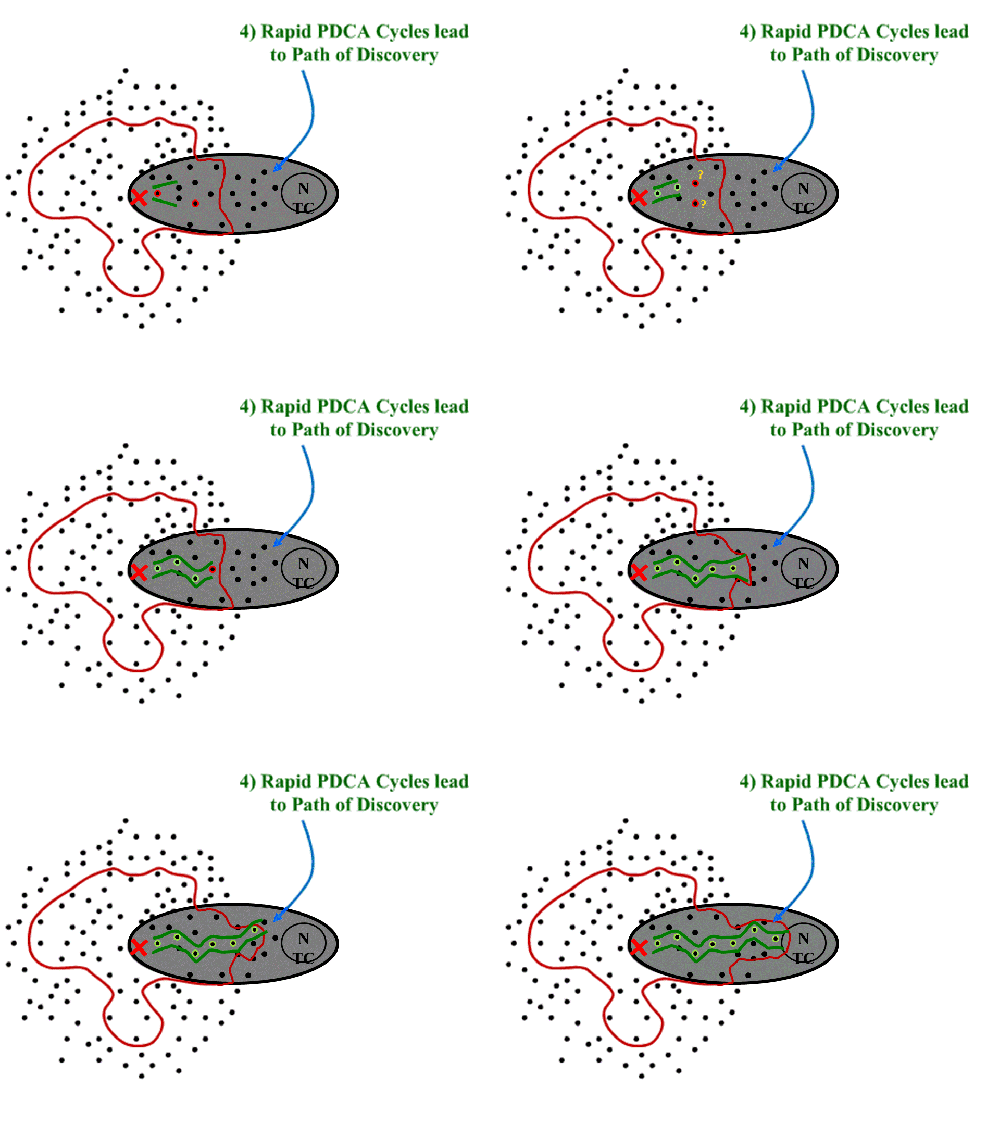
A few weeks ago I expanded on a great presentation by Bill Costantino that explained the relationship between challenges, targets, kaizen and the knowledge space of the company.

In that post, I created an animation of Bill’s graphic that illustrates progressive targets pushing the threshold of knowledge relentlessly toward the objective.

In this model, although we have a decent idea where we are, and what we want to end up with, the details of the path to get there are not known in advance.

Lean Leadership illustrates the same point quite well with the story of a factory kaizen team at TMMK (Toyota’s Georgetown, Kentucky facility). Of note is that this team is made up largely of production workers. It isn’t “the improvement team.” It isn’t an engineering department team. It is the people who have to live with the solution.

The team’s challenge was to improve a wasteful process for handling and moving sheet metal parts through the plant to the point of use on the assembly line.

They started by studying another company’s solution to the problem.

Did I mention that this team of factory workers from Kentucky spent two weeks in Japan studying this supplier’s system? Why make this kind of investment? Ponder that a bit, we’ll get back to this too.

Once back in Kentucky, the team had a clear sense of the challenge, and set out to progressively develop their own solution by experimentation, observation, and learning.

First they tried copying the benchmarked system on a small-scale test to deepen their understanding of what they had studied. Trying it on their parts surfaced differences that weren’t obvious at first, and they learned copying definitely wouldn’t work.

Key: The reason they tried to copy was to learn more about it. This was a small-scale concept test, not an attempt at wholesale implementation.

Even if it had worked, copying develops no skill other than reverse-engineering someone else’s solution that was developed for a different problem in different conditions. When people then say “See, it won’t work here” this is likely how they got to that conclusion. Too many companies “benchmark” and then try to do this. This team took a completely different approach.

“OK, cool, it didn’t work. Try something else.” And that is how learning happens.

They go back to grasping the original problem – damage from forklift handling. This is crucial. So many teams get bogged down on defining the “problem” as “making the fixed solution work” and end up expending a lot of effort in a tunnel with a dead-end. This is about exploring possible solutions to the actual problem.

They end up developing something quite different from what they benchmarked, that delivered the right parts, in the right orientation to the assembly operator. They knew this because they were their own customers – these were people who did this job.

Once they had it working on a sub-set of easier parts, they expanded the concept step by step (a few parts at a time) to handle the larger ones.

Key: Get the simple version working before trying to add complexity. Control your experiments. This is how learning happens vs. “just fiddling with it until it works.”

They proceed step by step – now sharing back and forth with the benchmark company who is seeing their solutions and building on them, until they have an AGV pulling a sequenced line of part carts that were loaded by robots, everything moving at takt.

Still, there was a lot of human interaction and they kept working to better synchronize everything.

Step by step, they worked their way back into parts that came from outside suppliers, dealing with one issue at a time.

Then a remarkable thing happened:

…at some point an hourly team member asked why the company was spending so much money to buy AGVs from external suppliers. Toyota manufactures vehicles, after all. Team members found they could buy the little robotic device that pulls the carts and custom-make the carts themselves.

But they didn’t stop there.

Later they discovered they could buy inexpensive, generic circuit boards of the type used in the AGV and program the boards themselves so that the AGVs would stop and wait at certain points along the line. Programming the AGVs themselves was a breakthrough, since it cut out licensing fees and added the flexibility to reprogram them. The original AGVs cost about $25,000 each; the ones built in-house cost under $4,000. With more than 100 AGVs in use, the team members kaizen initiative saved TMMK more than $2 million.

Let’s take a step back from this and look at what was really happening here.

What did these team members know at the end of this process that the didn’t know at the beginning?

What knowledge did they add to the company’s capability? Beyond the simple technical solution, what else did they learn? What confidence did they gain?

In other words, how did participating in this process improve the capability of the team members to improve other processes?

What would it be worth to your company to have team members who could think like this? (Hint – you already have them)

I promised to address a couple of points later. Here they are:

The role of managers vs. the management system.

The management system in any company is rightly focused on ensuring that operations are delivering the most customer value for the least cost. This is true of any value-creating operation, be it organized for profit or non-profit.

But the picture being painted by Liker and Convis is one where this management system works by ensuring the managers (that is, the individual people who are responsible for the operation) are focused on developing people’s capability.

To do this, Toyota has a specific process for developing leaders to embrace this responsibility.

This isn’t a new message. But it is emerging more clearly and more consistently in the popular literature in the last few years.

Which brings us to who made the improvements.

In this example, the improvements were made by production team members.

The company probably could have achieved similar (or at least similar looking) results with a project plan and a team of engineers. It might have even been faster.

But the production workers would have learned nothing other than to accept whatever the engineers gave them.

It is unlikely it would have occurred to anyone to build their own AGVs and save another couple of megabucks.

And the capacity of the company for improvements would have remained the same rather than increasing. At some point, the rate of improvement is constrained by the resources that can be dedicated to the task.

So, while an individual improvement task might take longer as people learn, in the end there is a multiplier effect as more and more people get better and better at making improvements. Sadly, it is really impossible to assign an ROI to that, so traditional management doesn’t allow for it.

This post is long enough. There is more in Chapter 4 to talk about, but I want to get this out there.