When someone brings a problem to a leader, it is typical for the leader to begin asking questions. The intent of those questions can make a world of difference.
Diagnostic Questions
In what I would contend is the more typical case, the questions are diagnostic. The leader’s intent is to get more information so that he can then propose or direct a solution. I can certainly speak for myself that when I have knowledge in the domain it is really easy to just drop into this mode. Someone is asking for advice, and I naturally reflex to giving it.
Of course there are times when this is wholly appropriate. Think of a physician and a patient or an auto mechanic and a customer. The customer has a problem that they are not capable of fixing and is engaging an expert to fix it for them or at least tell them what they should do.
Development Questions
If the intent is to develop the expertise in people then the questions must be different. This isn’t about finding the answers, it is about teaching the questions. Here the leader is coaching. The questions are about helping the problem-solver find her threshold of knowledge and the next step to learn more.
In other words, rather than asking the diagnostic questions yourself (as the leader), it is about helping the learner determine what diagnostic questions she should be asking herself, and then going about finding the answers.
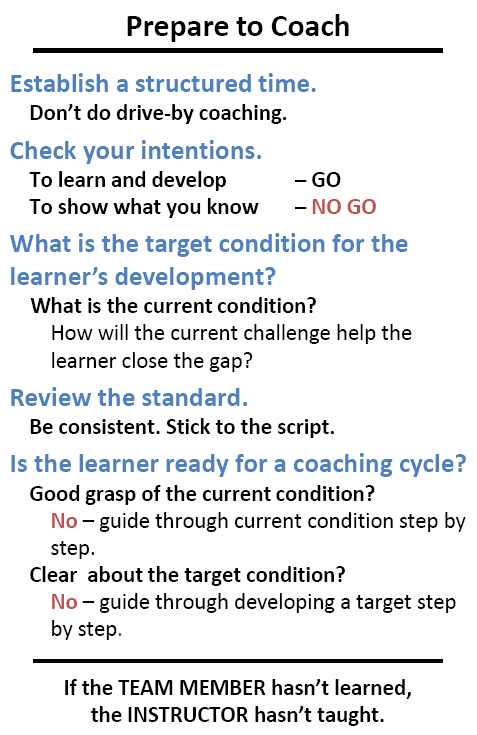
Click on the image to download a Toyota Kata coaching pocket card.
This is Harder and Takes Longer
In the short term, it is always easier to just give them the answers. We are all hard-wired to seek out affirmations of our competence. Equally, we are hard-wired to avoid situations that might call our competence into question. It is uncomfortable to be expected to know something we do not. This is part of being human. I would contend it is especially hard to resist showing what I know when I actually DO know (or think I do – though often I know a lot less than I assume).
It can also be frustrating for the learner, especially if they are used to just being told the answers. “Just tell me what to do” is a response that should clue you in to this frustration.
But if your intent is to develop the organization, you have to work a little harder.
Let’s Go See – and learn together
Even if I am asking diagnostic questions, I am likely to get to a point where I start hearing speculative answers or even a hard “I don’t know.” This is a great opportunity to shift gears from diagnostic to coaching with “Let’s go see so we can both understand what is going on.”
Now you can work together to help someone get deeper understanding of the current condition and the nature of the obstacles and problems being encountered. It is also a good opportunity to ask them to document what they are seeing in ways that help them explain it better.
This can take the form of a Toyota Kata storyboard, or an A3, or whatever other structure you are trying to teach and use for problem solving and improvement.
If done well, you will turn “What should I do?” into a learning and growth opportunity for everyone.
A few years ago I was working with a company that was ramping up a complex highly-automated production process.
A group of technicians had an idea for an improvement. The nature of what they were trying to improve, or their idea is irrelevant here.
They brought their idea to the plant manager, carefully explained it, and then a bit of awesomeness happened.
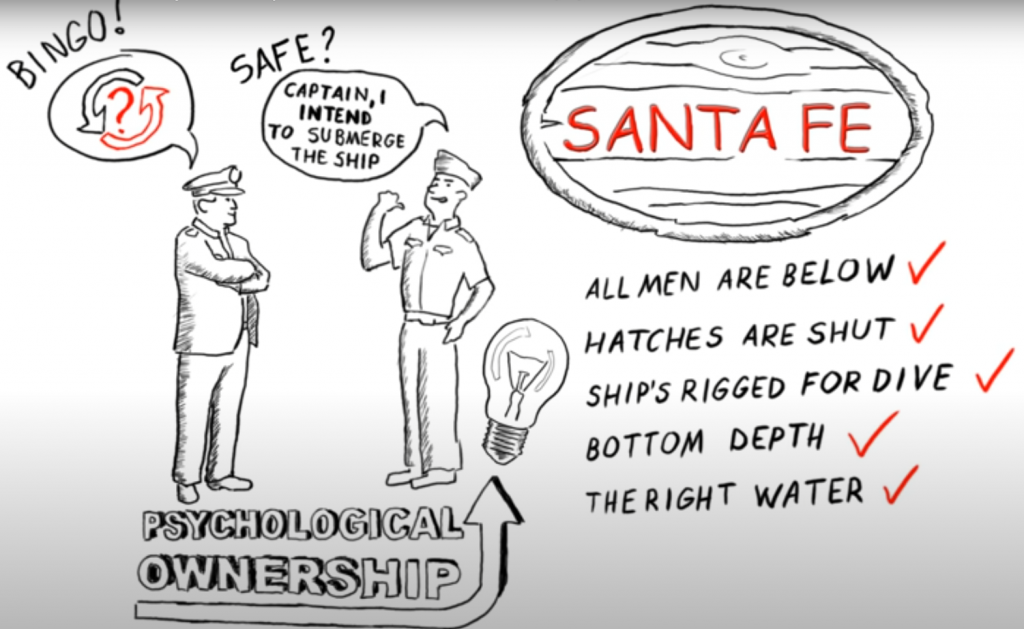
Instead of being critical or asking a lot of leading “What about…?” questions, he borrowed and paraphrased a question from David Marquet:
“What things do you think might concern me about this?”
The technicians were stumped. So the plant manager then said “That’s OK, how about getting back to me tomorrow with what you think?”
The next day the technicians had revised their idea to deal with potential problems the plant manager hadn’t even thought of. Which makes sense because they knew a lot more about how things worked than he did.
By asking that question he pushed them to think of the higher level systems implications, to think like the plant manager who has customers and constituents he has to please above and beyond the scope of the shop floor itself.
How do you respond when someone presents an idea? Do you critique it? Do you try to come up with scenarios that break it? Or do you challenge people to go back and think a little more deeply about the what if’s?
Whether you are a line leader or an internal or external consultant, if you are reading this you are likely working to shift the culture of your organization.
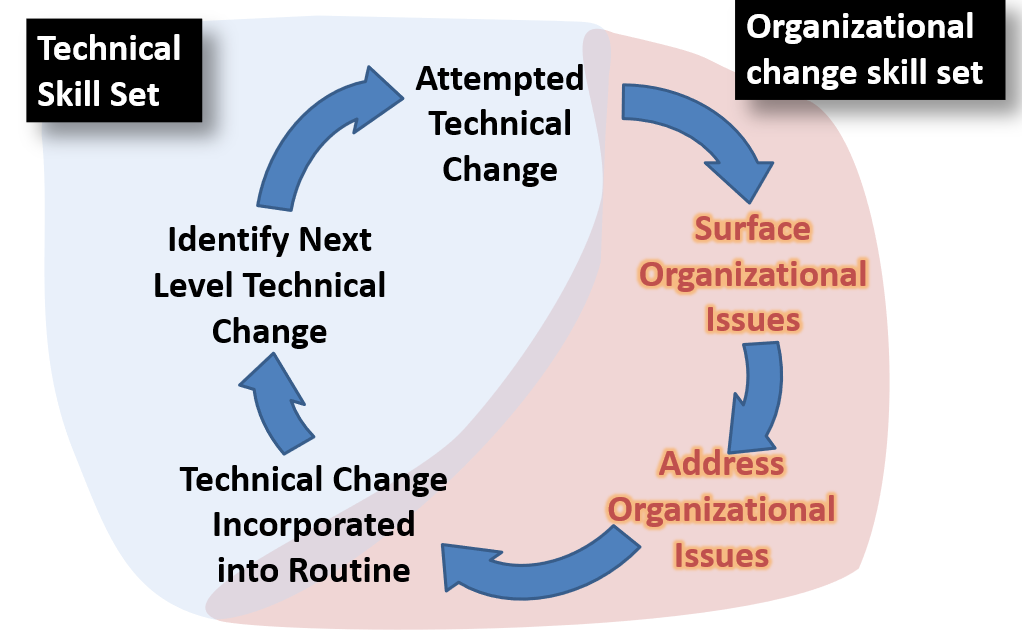
The technical “tools” alone are pretty useless unless you are already operating in the kind of culture that embeds the mechanisms of learning and collaboration deep into the structure of day-to-day work. If that kind of culture isn’t present, the “lean tools” will reveal those issues just as quickly (more quickly, in fact) as they reveal shortages, work balance mismatches and quality problems.
Making these kinds of changes is a lot harder than teaching people about how the “lean tools” work, and a lot of change agents are frustrated by the perception that the changes are not sustaining or being supported.
Back in February 2019 I gave a talk at KataCon5 in Savannah on some of the challenges change agents face when trying to influence how people respond to challenges and interact with one another. Here is the direct link in case the embed doesn’t work for you: https://youtu.be/NnvwOF4J3g8
As you watch the video (assuming you are *smile*) give some thought to how well you can paint a picture of how your efforts are influencing the patterns of interaction within the organization. Do you have something in mind for what you are trying to achieve there? What patterns are you actually observing?
And what is your role in those dynamics? How do you influence the patterns of who talks to whom, how, when, and about what? Are you acting as an intermediator between groups that don’t communicate or who are antagonistic toward one another? If so, what would happen if you stopped?
What happens when a production team member, or a nurse doing rounds on the med-surg floor, or your front-line customer service agent encounters something that is different than it should be? What is the threshold of starting action?
All of these things are cultural norms. And the “lean tools” all impact those norms in ways that people often are not prepared for.
None of these questions are on a checklist. Rather, they are the kinds of things to think about.
Sometimes the situation arises where the learner has been beating her head against an obstacle with little or no luck overcoming it. The question comes up: When is it OK to give up and switch to something else.
The answer is, of course, a little situational. (Consultant speak: It depends…)
The natural progression of the Improvement Kata will provide an opportunity.
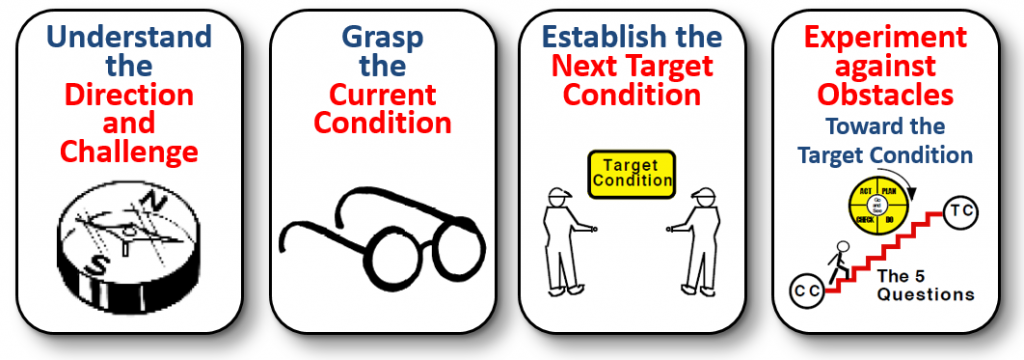
Improvement Kata steps by Mike Rother
As the learner is iterating against obstacles toward the Target Condition the clock is ticking because the Target Condition is always associated with an “achieve by” date. If the Target Condition is achieved OR we hit the “achieve by” date without achieving it, the learner should cycle back to the beginning and:
Verify understand of the direction and challenge. (The learner may well have gotten more clarity along the way.)
Get a complete grasp of the Current Condition. This is important because often while working toward a Target Condition the learner is only updating specific process and performance metrics, and may not be looking for collateral changes elsewhere. This is a time to take a step back, put up the periscope, and get a grasp of the complete picture.
Based on that new Current Condition, establish a new Target Condition, with a new “achieve by” date.
Now… identify the obstacles in the way of achieving that new Target Condition. Ideally they should wipe the obstacle parking lot clean and take a fresh look.
This process often helps clear the learner’s mind and see another way to get there, or see easier obstacles that were overlooked before.
This is also why it is important for the “achieve by” date to be relatively close (a couple of weeks) – because that date is a safety valve that forces a reset of the process if the learner is stuck.
If the learner asks if it is OK to work on a different obstacle, then the coach should become curious about the learner’s rationale.
Specifically, I want to understand why the learner thinks there might be an easier way vs. just saying this one is too hard. This may well require some more information gathering – a mini version of the reset I talked about above.
The key point here is to maintain the learner’s motivation. There is a fine line between struggling to solve a problem and getting frustrated. This might be a good time for the coach to engage in some empathetic questioning.
For example, name the feeling you are picking up to test your hypothesis: “It seems you are really frustrated by this…” Then listen. The learner will likely either agree, “yeah, I am.” or refute and give you more information, “No, I’m just trying to…” Then you might learn more about their threshold of knowledge with the process of problem solving.
That can open up a discussion for why the learner thinks it would be a good idea to try something else. Then use your judgement.
But as a coach, I don’t want to make switching obstacles too easy because there is a high risk of it becoming a whack-a-mole game. Some obstacles actually require digging and perseverance to overcome. Your job, coach, is to keep the learner in the game.
Sometimes, though, the learner gets fixated on a problem and doesn’t see another way. Even in this case, if the time to the “achieve by” date is short, I’d let it ride. But if that isn’t practical…
The coach may well have a broader perspective – in fact, this is part of the coach’s job.
If the learner is making progress on something I (the coach) consider a red herring, I generally let it go. There is always learning involved – so long as the effort doesn’t bog down progress.
Sometimes, though, the learner is getting frustrated and so focused that he just doesn’t see any other way.
This is time for gentle intervention with whatever questions might help the learner pause, step back, and see the bigger picture.
For example, perhaps something like “If this obstacle were cleared, how would the process operate?” This might not be the full target condition. I’m just trying to learn what “solved” looks like to the learner. Maybe just thinking about it will help them see the where they are trying to go and possibly another path to get there.
An interesting follow-up might be, “Hmmm, what’s stopping it from working that way now?”
“What would you need to learn to better understand what is going on?” might be another avenue to get the learner to look at his threshold of knowledge vs. the big ugly obstacle in front of him
It all depends on what you think will help the learner raise her head and take a different look at things.
But in the end, if you have a learner that is truly stuck, and after a few tries isn’t going to get unstuck, then, honestly, it’s time to go shoulder-to-shoulder with them and dig into things together.
What I would work very hard to avoid is direct intervention – “Why don’t you work on…” because this undermines the entire process by giving them the answers and can easily create a “what do you think I should work on?” expectation next time.
In Western business it is pretty typical for someone to be assigned to come up with a proposed solution to a problem, and then seek approval for that solution. In some companies that consider themselves more forward thinking, they might even say something like “bring me an A3.”
As a result I have seen a number of organizations that produce some kind of guideline for “how to fill out and A3.” They teach “problem solving” courses so people can learn to do this properly. I have developed, and delivered, a couple of those back when I was working in internal continuous improvement offices. We had case studies, exercises, all in an effort to teach people to be better problem solvers.
Similarly, a (very) long time ago, I recall an exchange on an online “lean” forum where someone had asked about Toyota’s “problem solving class.” The thought was that because Toyota has good problem solvers, that their course must be really good.
My response was that I have a copy of Toyota teaching materials for a problem solving course. It is good, but nothing magical. Because that isn’t how Toyota develops good problem solvers.
They do it with coaching.
What makes the “A3” process work isn’t the A3, or even the structure. It isn’t the instructions, guidelines, or the quality of the problem solving classes.
It is the almost continuous interaction between the problem solver and the coach.
The problem solver’s thinking is challenged. “What evidence do you have?” “Have you tested that assumption?” “How is that happening?” “Why do you think that is the problem?” “What are you planning for your next step?” “What do you expect to learn?”
And it is the coach’s stubborn refusal to give the problem solver the answer. Rather, they insist on following the rigor of the problem solving process using scientific thinking.*
The process is an application of the principle of “Challenge” followed by support to enable the problem solver / learner to meet the challenge. They have to bring perseverance to to the table, but the coach is there to make sure they actually learn to be better problem solvers in the process.
Likely (if you are reading this) you already know that. We knew that when we worked so hard to make those A3 guidelines and problem solving courses. But we did those things anyway.
Why? Because it is easier to develop and deliver those general class materials than it is to develop managers into coaches and leaders.
But the fact remains:
If you want to develop better problem solvers, what you need are better coaches.
The implications here are really profound for most organizations.
If you assign someone to solve a problem, to “do an A3” (or whatever structure you use), you are obligating yourself to coach them through the process.
This is far more than getting status updates. And it is far more work. Because you are teaching, not just supervising. If they fail, it’s on you, not them. “If the student hasn’t learned, the teacher hasn’t taught.”
In Toyota Kata world we have reduced those questions down to the critical few in the Coaching Kata. That, of course, is a start. Your job as a leader is to practice until the flow of the logic is second nature to you, until you can go beyond the script. Until your first-nature, reflexive response to anyone proposing to do something is “What problem are you trying to solve?” or “What are you trying to learn?” and then carefully listening to their logic and pushing them to the edge of their ability with the next step.
When you can take your own coaching training wheels off, you can then (and only then) ask someone else to ride a bicycle for you, because you will know how to teach them to ride – and that involves more than sending them to a PowerPoint lecture on “Riding a Bicycle.”
“Because knowledge is not understanding” – Destin Sandlin.
———
*Some years ago I worked briefly with a manager who had been one of the key players in Toyota’s initial startup of their plant in Kentucky (TMMK). He told me an interesting story. In the beginning, he noted, the U.S. managers would go to their coordinators (Japanese Toyota senior leaders there to advise the new team) and ask for advice.
Then one week all of the U.S. team went through the problem solving / A3 course. The following Monday, he went to his coordinator with a question, and the response was “Doug-san, where is your A3?” After that day, the coordinators would not engage unless there was an A3 that outlined, in writing, what the manager already understood about the problem, what he was seeking to learn, and how he proposed to go about learning it.
Think about that story vs. sending people to “problem solving class” or even a “Toyota Kata” class. When they return, do you insist that they apply what they have learned whenever it is appropriate from that day forward? If you don’t then you are wasting their time and your money sending them to that class. They will never develop the skill without practice, and it is always easier not to practice something we are not comfortable doing.
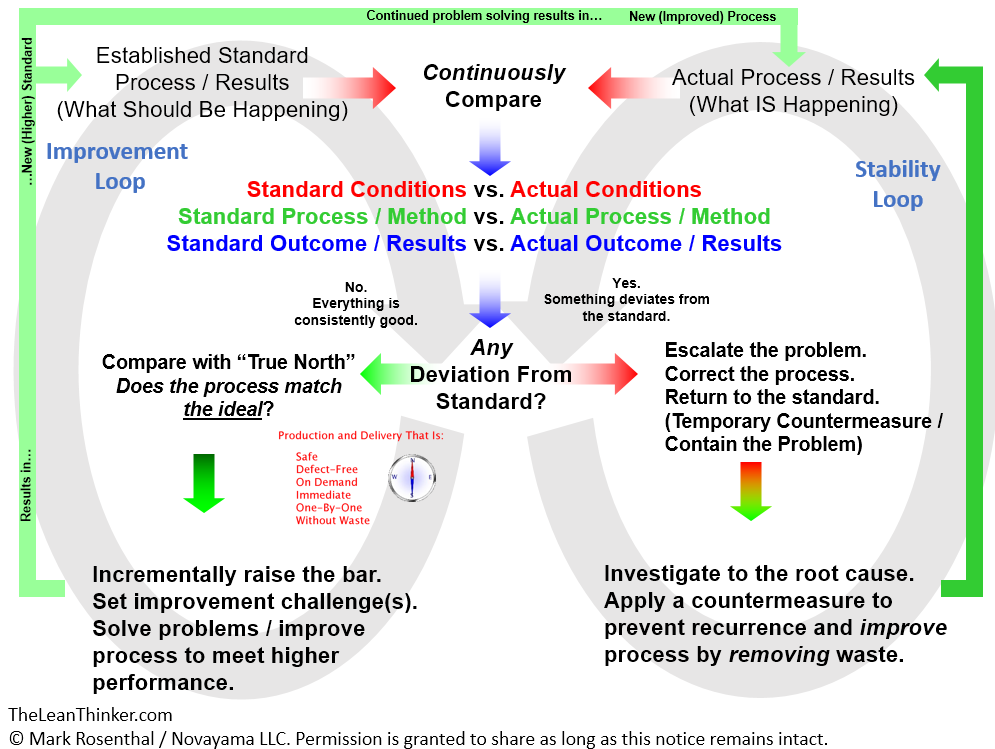
I’m digging through old archives again, and came across this graphic I put together around 2006 or so. It depicts more detailed version of “Organize, Standardize, Stabilize, Optimize” showing the continuous comparison between “what should be happening” and “what is actually happening.” It is the gap between these two that drives improvement forward.
Like the pocket card in the last post, this is built on a foundation established by the work of Steven Spear, especially his PhD dissertation that is summarized in Decoding the DNA of the Toyota Production System. By the way, if you are in the business of continuous improvement, reading (and understanding) this breakthrough work is critical for you.
Other than generally sharing this, my other reason for putting this up is that in the Toyota Kata community there has been discussion for about a decade about whether or not the right hand loop – pushing for stability – is an appropriate use of the Improvement Kata.
I think that is an unfortunate result of some very early conversations about the difference between “troubleshooting” and “improving” a process. We get into semantic arguments about “problem solving” as somehow different from “root cause analysis” and how the Improvement Kata is somehow distinct, again, from those activities.
This makes no sense to me for a couple of reasons.
Scientific Thinking is the Foundation
Toyota Kata is not a problem solving tool. It is a teaching method for teaching scientific thinking, and it is a teaching method for learning to teach scientific thinking. In the books and most literature, it uses organizational processes as working examples for the “starter kata,” but exactly the same thinking structure works for such diverse things as working through quality issues, developing entirely new products and processes, working through leadership and people issues. The underlying sub-structures may change, but the basic steps are the same.
When I encounter an organization that already has a “standard problem solving approach” I do not attempt to tell them they are wrong or confuse them by introducing a different structure. Rather, I adapt the Improvement and Coaching Kata to align with their existing jargon and language, and help them learn to go deeper and more thoroughly into their existing process.
Stability is a Target Condition
I see a lot of pushback about working to “return a process to standard.” In reality, that is the bulk of the activity in day-to-day improvement. The whole point of having a standard in the first place is to be able to see when the actual process or result is somehow different.
Think about it: If there isn’t an active means of comparing “actual” vs. “standard” what is the point of having a standard in the first place?
Think of the standard as a target condtion.
What obstacles are preventing you from [operating to that standard]? You can guess, but the best way is to diligently try to operate to the target condition and see what gets in your way. That might not happen immediately. Maybe some time will go by, then BAM! You get a surprise.
This is good. You have learned. Something you didn’t expect has interfered with getting things done the way you wanted to. Time to dig in and learn what happened.
Maybe there was some condition that you could have detected earlier and gotten out in front of. Who knows?
You Cannot Meet a Challenge Without Working on Stability
As you are working to reach new level of performance – working toward a new challenge – there will be a point when the process works sometimes, so you know it is possible. But it doesn’t work every time because there are still intermittent obstacles that get in the way.
Nevertheless, you have to work diligently to see problems as they occur, respond to them, dig into causes (root cause analysis anyone?) and systematically protect your process from those issues.
The only real difference between covering this territory for the first time vs. trying to recover a previously stable process is that in the later case you can ask “What has changed?”
But, in the end, in both cases – stabilizing a new process vs. re-stabilizing an old one – you are dealing with conditions that are changing from one run to the next. That is why it works sometimes and not others. You don’t know what is changing. You are trying to figure it out by experimenting and learning.
What About Root Cause Analysis?
My challenge is still a stable process.
My current condition is my level of understanding of how the process works today, and the exact mechanism that results in a defect. Even defects are produced by a process – just not the process we want.
That understanding will be incomplete by definition – because if we truly understood what was going on we wouldn’t have the problem. So… what do I know (and can prove with evidence) and what do I not know.
What do I suspect? What evidence do I need to gather to rule out this possible cause, or keep it in play? Next experiment. What do I expect to learn?
I’ll write a more detailed post about this at some point. I think it is a topic worth digging into. Suffice it to say that I have absolutely used the Improvement Kata structure to coach people through finding the root cause of wicked quality problems.
It really helped that they were able to see the same underlying pattern that I had already been teaching them. It made things simpler.
Don’t Complicate a Simple Concept
It’s all “solving problems” (the term “problem solving” apparently has some specific form it needs to take for some people).
The underlying structure for all of it is scientific thinking. Some say it’s PDCA / PDSA. Same thing.
Splitting semantic hairs and saying “this is different” makes simple things complicated. Yes, there are advanced tools that you use when things get tough. But… addition and subtraction; basic algebra; advanced polynomials; basic differential calculus; advanced multivariate calculus – IT IS ALL MATH. You apply the math you must to model and solve the problem at hand.
DON’T apply more math than you need just because you can. That serves no purpose except, perhaps, to prove how smart you are… to nobody in particular.
Solving problems is the same. There are some cases where I need to develop a designed experiment to better understand the current condition – the interactions between variables. There are cases where other statistical tools are needed. Use them when you must, but not just because you can.
Outside of the actual operation, the default meeting schedule for most organizations is weekly.
This is OK when everyone understands what is expected and the default thinking and behavior is working for you.
With Toyota Kata, though, the intent is to practice a routine that is not default thinking or behavior. Yet many organizations fall into the default of a weekly coaching cycle.
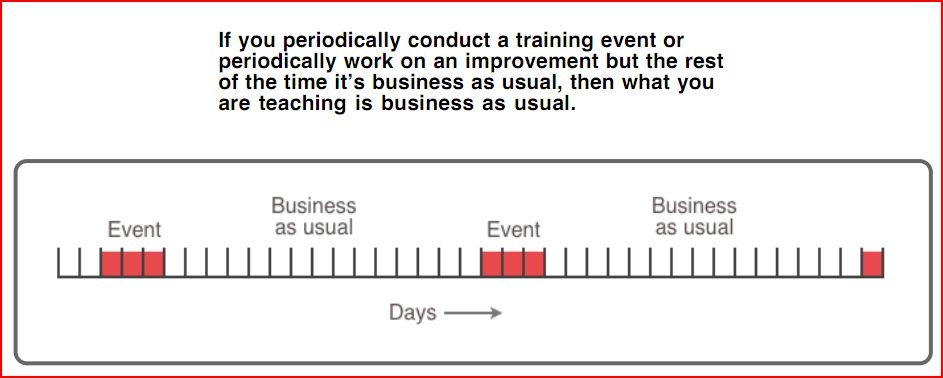
What we have to remember is that the coaching cycle, and the learner’s preparation for the coaching cycle, are practice. The time(s) that you aren’t practicing you are engaging in the default, and if the default isn’t what you want it to be then it will easily overpower what you are trying to learn.
15 minutes a day is practice. 15 minutes a week is dabbling.
It is the same as a supervisor’s area experiencing one or two “kaizen events” a year. It is just dabbling with kaizen, not practicing it every day, and certainly not immersion. They aren’t going to learn to think differently with that kind of cadence.
Illustration courtesy of Mike Rother
Batch Production of Experiments
One of the reasons we want to drive toward one-by-one flow in production is so we can have one-by-one confirmation of products vs. waiting for a huge batch to be produced only to discover that they all have problems.
Breaking it down even further, we want one-by-one confirmation of operations so that we don’t keep working on something that is already unusable from something earlier.
Likewise, if a learner is running many experiments without checking in with a coach, he can get pretty far off track without realizing it. The coach can provide a valuable outside check to make sure the learner isn’t getting locked on to something that is distracting him from the bigger picture.
Remember: This is about developing people
Before you jump in and say “But I don’t have time…” consider the alternative.
How much time do you, as a manager, spend intervening in problems that you think people should be able to solve on their own? If you keep giving them the answers, they are going to keep brining those issues to you.
With a little bit of thinking, the Coaching Kata cycle can be easily spliced on to David Marquet’s “Ladder of Leadership” and guide your conversations away from intervention and toward creating able problem solvers.
But before you can do that well, you have to practice the Coaching Kata until asking those types of questions becomes second nature to you.
This isn’t all about the learner’s development! If you only practice coaching once a week, whatever your default is today will likely remain so tomorrow. Change requires repetition and practice.
Continuing my breakdown of Billy Taylor’s opening keynote at KataCon…
Key Bullet Points
People follow what you do before they follow what you say.
If you (as a leader) think you are above the process…
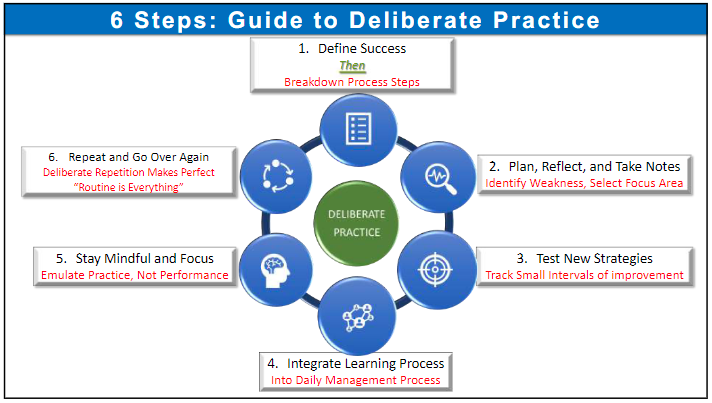
Deliberate practice on your practice of leadership. Focus on one thing.
Break down your leadership style [into elements]. Practice deliberately on one thing you want to reinforce or improve.
That second bullet is a real challenge for those of us who are in leadership positions (or even positions of influence). “If you think you are above the process…” – do you follow the standards and expectations you ask of others?
I think a good test would be “If a production worker corrected you, how would you respond?” If your internal emotional response (that initial feeling you have, not how you show yourself) is anything other than “Thank you for reminding me” then you are exempting yourself from the rules.
The other take-away:
Throughout his presentation, Billy was tying together the idea of “deliberate practice” and “developing leadership skills.” Leadership is a process, and processes can be broken down into their constituent elements and practiced.
This ties back perfectly to a broad spectrum of leadership development models. In the end, what we can control are:
What we say.
How we say it.
Who we say it to.
The structure of the environment that either inhibits or encourages the behaviors we want.
All of these things can be developed through experimentation, and then practiced. This is what Toyota Kata is about.
The first official day of KataCon kicked off with a keynote on deliberate practice by Billy Taylor. I first met Billy back in 2012 when I was doing some work with Goodyear. When I saw him at last year’s KataCon it was like running into an old friend, but that is who Billy Taylor is – even if you just met him.
Billy Taylor on Deliberate Practice
Pull quotes and thoughts
The Concept of Deliberate Practice
Toyota Kata has two sides, like a coin. On one side is scientific thinking. On the flip side is deliberate practice.
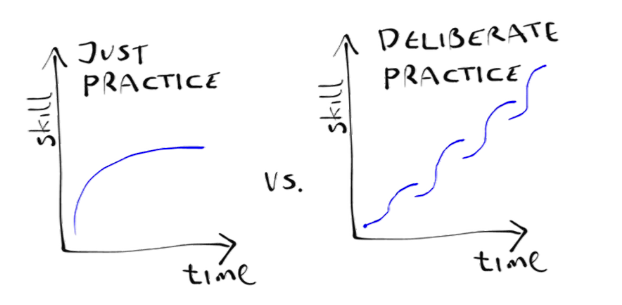
Traditional practice is often just mindless repetition. Deliberate practice has focused attention on perhaps one aspect of the routine.
A couple of things come to mind for me here. First is that too many coaches go through mindless repetition of the Coaching Kata. They just ask the next question on the card, and never practice using the questions to nudge the learner’s thinking to the next level.
This means they never practice in a way that pushes them as coaches. More about that below.
The other is that we, all too often, take a learner through the entire process much too fast. We do this in classes to give them a taste of the whole process. But in real life, perhaps it would be best to anchor each Starter Kata step and ensure there is at least understanding before moving to the next.
When 2nd coaching it is equally important to focus both the coach AND the learner on improving a single aspect of the board.
As I am writing this, I am reflecting more, and parsing more. This slide offers a ton of insight for me:
From Billy Taylor’s KataCon6 Presentation
There is so much here on a lot of levels.
This is how I interpret the graphs: On the left we have “Just Practice.” Maybe I am learning to play a song on the guitar. As I practice I learn to play it better and better. Then I hit a plateau because I am comfortably good and not challenging myself anymore. I am just playing. And that feels awesome, because I validate to myself that I am pretty good.
At a higher level, this is the “lean plateau” that so many companies hit. They get really good at running kaizen events, or black belt projects, or whatever they do. They hit a pretty good level of performance, but things erode. They reach a plateau when the implementers are spending all of their time re-implementing what has eroded. They shift into mindlessly repeating the familiar rather than challenge themselves. What are we missing? Why is the skill concentrated into the same half dozen individuals who have been doing this since 1999?
The graph on the right represents something that is the same, but different. Take a look – each little squiggle repeats the graph on the left, only smaller. Each time a plateau is hit, the learner challenges herself to practice a new aspect. Things get a little worse for a bit, then as the new aspect is mastered, the process is repeated.
I see the job of the coach as two fold:
To challenge the learner in small steps, always looking for the obstacle to the next level of performance.
To offer up specific things to practice.
Billy’s presentation covered a lot of overlapping territory – enough for at least two more posts – stay tuned.
This is the first in series of posts I am drafting about what I saw, heard, learned at KataCon6 in Austin.
I was originally writing this up in huge chunks, maybe two posts. But when I bounced the “Part 1” draft off Craig Stritar, I got some good advice – there are a lot of topics here, and it might be more useful to break these up into smaller pieces, so that is what I am doing.
My intent is to generate discussion – so I would like to explicitly invite comments, questions and especially take-aways from others. In other words – let’s continue the great conversations that were taking place in Austin.
Day -1 and Day 0
Lean Frontiers traditionally runs the TWI Summit and KataCon back-to-back in the same week, alternating which comes first. This year the TWI Summit was Monday and Tuesday, and KataCon was officially Thursday and Friday.
Both conferences, though, have semi-formal activities and get-togethers prior to the first official day. Since there are things going on Wednesday, some people begin to arrive Tuesday evening. And because I was already on site from the TWI Summit, Tuesday evening is really when things got started for me.
Something I have observed in the past is that each KataCon seems to take on an informal theme of its own – a common thread or feeling that is established more by the participants than the presenters. Where the first KataCon was the excited buzz of a community coming together for the first time, this one seemed to me to be like a reunion. To be clear – it was a welcoming reunion. Unlike other conferences I have attended, there is nothing “clique-ish” about this one.
With that reunion theme, I want to give a shout out to Beth Carrington. She is a vital member in the fabric of this community and this is the first KataCon she has missed. I think I can speak for all of the regulars when I say “we missed you.” Those who do not know you still felt your presence and influence through your impact on the rest of us.
The other thing (for me) that was cool was just how much of the conversation took place after hours in the hotel lobby bar. There were long-time regulars catching up, and there were first-timers and newbies getting rich tutorials and insights from the veterans. That is why I titled this section starting with day “-1.” Those conversations were happening on Tuesday afternoon and evening as people started to arrive.
This is a community of sharing. Many of us are consultants and nominally competitors in an increasingly crowded market. Yet nothing was held back. We build on each other’s stuff, and pretty much everyone shares what they are thinking with everyone else. That’s pretty cool in my estimation.
The Kata Geek Meetup
Kata Geek Button from KataCon 1
The Kata Geek Meetup started at the first KataCon. At the time it was an informal mailing list invitation to attend a get-together before the conference started. Everyone got a “Kata Geek” button to wear with the idea that the other conference participants could identify those with a bit more experience under their belt if they wanted to ask questions, etc. The event wasn’t publicized on the conference agenda.
Over the years this has morphed into a mini-preconference that is open to all who can attend. People share brief presentations – maybe something they want to try out for an audience, maybe a rhetorical question, maybe a “what we are learning.” The pacing is much more flexible than the actual conference, and there is time for lively discussion and Q&A. Sometimes tough, challenging questions get asked – though always in the spirit of curiosity rather than trying to one-up anyone.
As I get into the actual content, I want to clarify my purpose in writing what I do. When I listen to presentations, I am more likely to take down notes of what thoughts or insights I take away than the actual content. These things are often a fusion of key points the presenter is making, or the way they are saying something, and my own paradigms and listening framework. That is what I am writing about here. I am not making any attempt to “cover” the presentations as a reporter or reviewer would or be complete in mentioning everything that was said.
PLEASE contribute in comments if something I didn’t mention resonated with you, or something written here sparked another thought for you.
Dorsey Sherman made a simple point: All coaching is not the same. It depends on your intention (as a coach).
Thinking about it a bit, the classic TWI Job Relations is coaching – usually (in its original form) to fix or change behavior in some way. TWI Job Instruction is coaching – in this case to teach / coach for skill. At a deeper level, the classes themselves are designed to give novice coaches a structure they can practice.
The Improvement Kata framework itself is a pretty universal structure that I can pour a lot of different intentions into and test ideas that I think will move me in a particular direction. I think all coaching is a process of exploring and experimentation simply for the fact that we are dealing with other people. We may begin with assumptions about what they think, know, feel but if we don’t take deliberate steps to test those assumptions we are just guessing in the dark.
Hugh Alley
Hugh is a friend from neighboring beautiful British Columbia. I recall telling an audience in British Columbia that Canada represents that nice couple living quietly in an apartment over a rowdy biker bar. 😉
A couple of take-aways I noted down as Hugh was speaking:
The storyboard represents a picture of the learner’s mindset – it is like an MRI.
Correction: Hugh informs me (see his comment below) that the MRI analogy came from Panos Eftsa.
I loved that analogy. When I look at the storyboard I am really seeing how organized the learner’s thinking is, how detailed, and whether or not they are connecting the dots of cause and effect from the levels of their target conditions to their metrics down to their experiments and predictions.
I thought of an image like this:
Public Domain: From Wikimedia Commons
Hugh was asking the audience about his situation of a client company that started up 13 storyboards at once. Some of the thoughts that came out:
Um… OK, you have already done that. *smile*
Establish a specific area of work for each board, each coach. Don’t try to bring them along all at once.
Work through each phase of the Coaching Kata, anchor success and mastery one-by-one rather than trying to batch everything through at once.
What was good about his client’s approach, though, is they are establishing a routine of people talking about why the work is the way it is – and that is awesome.
Toyota Kata Level-Set
At this point I am letting go of trying to write in the sequence of the agenda. There are topics I want to go deeper into, others I may combine.
Oscar Roche
The Toyota Kata Summit attracts people across a wide spectrum of knowledge and experience with “Toyota Kata” itself. Balancing the conference can present a real challenge. There are people who have been practicing this in the trenches for a decade and are pushing the boundaries. There are people who might have read the book and are curious about learning more.
One of the countermeasures is a “level set” presentation at the beginning of the formal conference. This is a brief overview of the fundamental principles of Toyota Kata and I think it is a good grounding for the veterans as well – it is always good to pull us back to the basics now and again.
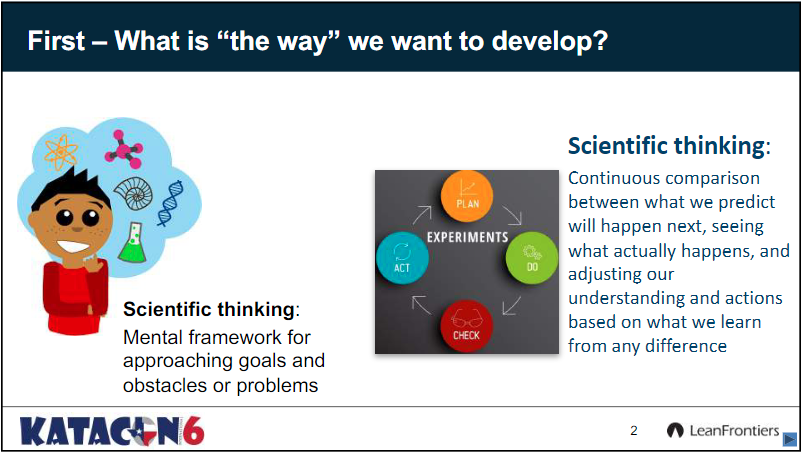
Traditionally Mike Rother has done the “level set” presentation. This year, though, was a change and Oscar Roche stepped up. Oscar’s title slide drove home a critical point that we often miss:
“Kata is the a thing that helps you develop the a way”
His next slide answers the implied question:
My thoughts – and a digression
A lot of practitioners get hung up on the idea that the way they know best is the best way, sometimes to the point of believing it is the only way. This is true for Toyota Kata practitioners, general “lean” practitioners, Six Sigmites, Theory of Constraints, TQM, you name it.
Sometimes I hear people make sweeping statements that dismiss an entire community, perhaps focusing in on one thing they perceive as flawed. “Lean addresses waste but not quality (or not variation).” “TOC doesn’t address flow.” “Six Sigma is only about big projects.” “Toyota Kata is only about the storyboard.” All of these statements are demonstrably false, but it is hard to have an open minded discussion that begins with an absolute.
All (credible) continuous improvement has a foundation of scientific thinking. Any approach you take has some basic “first moves” to get you started thinking that way. Toyota Kata is more explicit about that than most, but the underlying principles are the same across the board.
Oscar’s opening slide emphasized this point: Toyota Kata is a way, not the way. We can all learn to adapt vs. continuing to hammer on a nail that has hit a knot and is bending over.
Steven Kane
A teacher provides insight.
A coach pulls insight from the learner.
You may go back and forth between these two roles. Be crystal clear which role you are in at the moment.
I’ll probably write more about this in the future in a separate post. What I liked about this thought is that it is appropriate for the coach to provide direction or insight at times. My own presentation at KataCon kind of hinted at this – someone has to bring in the paradigm of what “really good” looks like.
Nevertheless, it is critical for the coach to drop into the “teacher” role only when necessary (which I think is a lot less often than we like to think it is), and then get back into true “coach” mode as quickly as possible. Why? Because unless I am in “curious” mode with my learner, I really have no way to know if my brilliant insights got any traction. 😉
Paraphrasing from Steven’s presentation, the question “What did you learn?” is there to see if there has been a moment of discovery.
The Power of Nothing
The most powerful follow-on question to “What did you learn?” is silence. If initial response is fluffy or vague, or you think there is more, just wait. Don’t try to say anything. The learner will instinctively fill in the awkward silence.
Target Condition vs. a Result
This came up a lot during the conference. Billy Taylor talked about the difference between “Key Activities” (KA) vs. “Key Indicators” (KI or KPI). What are the things that people have to do that will give us the result we are striving for? Leaders, all too often, push only on the outcome, and don’t ask whether the key activities are actually being carried out – or worse, don’t think about what activities are required (or the time and resources that will be required). I’m going dedicate a post on that topic.
And finally (and I am making this one bold so I remember it!) –
Don’t rob the leaner of their opportunity to make discoveries.
How often do we do that?
Michael Lombard
Michael had a brief presentation on “What we are learning” focused specifically into the health care field. His thoughts on medical students actually apply universally with anyone who perceives themselves as successful.
We need to de-stigmatize struggle. Productive struggle is part of deep learning. Medical students should not feel shame when they struggle to learn a new skill.
Why do they? Michael pointed out that the people who manage to get admitted to medical school are high-achievers. Things may well have come easily for them in high school and their undergraduate studies. Now they are in a group with other high-achievers, they don’t stand out from the crowd, and the concepts can be difficult to master.
We see the same things in other environments – a lot of people in senior positions of authority got there the same way. Many are ultra-competitive. Now we are asking them to master a skill that runs entirely counter to their paradigm of intuitive decision making. Note that that intuitive decision making has worked well for them in the past. But maybe they are at the limit of what they can do themselves, and have to find ways to engage others. I don’t know… there could be lots of scenarios that put them into completely unfamiliar territory.
Our challenge is how we de-stigmatize struggle.
Michael’s other key point touched one of the Wicked Problems in health care. I’m going to go into some more depth when I get to Tyson Ortiz’s presentation, but want to acknowledge the Great Question posed here:
“99% of activity needed to maintain wellness never involves a health system. Can we increase the striving capabilities and mental resilience of our patients, families, & communities so they can own their health journey?”
Amy Mervack
Amy tied our practice to the concept of “mindfulness.” One of her key points was learning to see that the pattern we are trying to teach may well be there in some form other than the explicit Improvement Kata.
She wrapped up with some guided practice of “being mindful” for the audience – which she said stretched her a bit as she had never done it with a group that large.
As a change agent, a mindfulness approach is critical. We have to learn to find everything about the way things are being done that we can leverage and extend. This means paying attention vs. the mindless approach of dismissing them out of hand with a single statement. Making people feel wrong may get attention focused on you, but it rarely helps make progress.
Experientials
The afternoon was “Experientials” – four hour breakout sessions that went deep into a particular topic. As Craig Stritar and I were hosting one, I didn’t attend any of the others. Always a downside of being up-front – I see more of my own stuff than the awesome things others bring.
As I mentioned above, I am going to be digging into some of the topics in more depth, and I want to keep those individual posts focused vs. trying to cover a rich diversity of discussions all at once. Hmmm… one-by-one vs. batching. That might be a concept. 😉